Loading home
Loading home
Skip to content
Blog
  1. Blog
  2. /
  3. Workflow guides
  4. /
  5. Sources to DOCX in Lattuce — end-to-end manuscript workflow

December 12, 2026 · Workflow guides

Sources to DOCX in Lattuce — end-to-end manuscript workflow

Upload PDFs, run missions, compose grounded sections, approve, and export to Word with real references — the full Lattuce Writer pipeline.

  • guide
  • writer
  • docx
  • citations
  • workflow
  • seo
LanguageEnglishBahasa Melayu

For in-app help, ask the product assistant about The Writer paper lifecycle (help doc writer-paper-lifecycle).

This guide walks the flagship path on lattuce.app: library sources → research missions → grounded writing → section approval → Word export with real references — not a chat summary you paste into Word by hand.
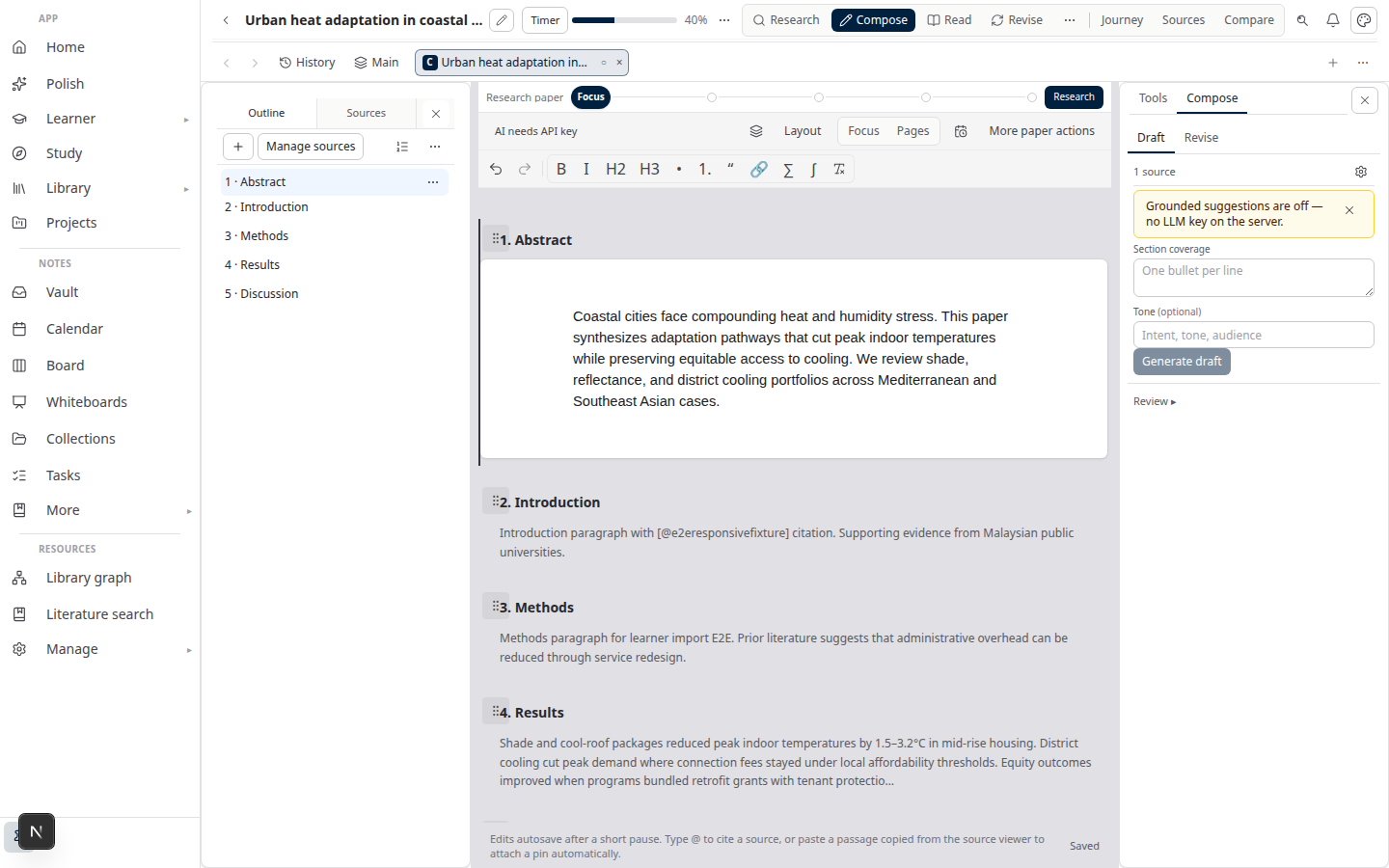
Lattuce Writer compose on lattuce.app

Who this is for

You are…This path helps when…
Thesis or article authorYour deliverable is a .docx with verified citations
PI skimming toolsYou want one account from PDF upload to export
Returning userYou know Lattuce basics and need the full pipeline checklist

New here? Start with try Writer without signup or literature review with Lattuce.

Before you start

You needNotes
A Lattuce accountSign in at lattuce.app
A paper projectLibrary → Papers → New paper
SourcesPDFs or Word files that reach ready status, or a topic for discovery missions
AI (optional)Add your own provider keys in account settings for missions and compose — see BYOK on Lattuce

Step 1 — Build your source library

Path A — you already have PDFs

  1. Open Library and upload PDFs or DOCX files.
  2. Wait until each row shows ready (text extraction finished).
  3. Open your paper and attach those sources in the left pane.

Path B — you have a topic, few PDFs

  1. Open the paper Research workspace.
  2. Run Quick search (literature discovery mission) and approve suggested papers.
  3. Optional ingest fetches open-access PDFs when they exist.
  4. Attach approved, ready sources to the paper.

Optional: sync from Zotero in Library → References — see Lattuce + Zotero.

Step 2 — Run a research mission

  1. In the paper workspace, open Research → Missions.
  2. Start a Literature review mission (requires attached, ready sources).
  3. Review the synthesis report and evidence matrix when the mission completes.
  4. Optionally download export.md or export.bib for handoff outside Lattuce.

For mission templates and approval checkpoints, see Research missions in Lattuce.

Step 3 — Compose with grounding

  1. From the mission panel, choose Compose from synthesis (or open Compose manually).
  2. Draft sections with cite chips tied to attached sources.
  3. Run citation checks — fix or remove claims the verifier flags before you approve text.

Compose is TipTap rich text by default. LaTeX and Typst are export paths, not the primary editing canvas.

Step 4 — Approve sections

  1. Open Write (or the section list on your paper).
  2. Review each section; mark it approved when citations and prose are final.
  3. Unapproved sections stay out of export — this is intentional. Academic export needs integrity, not simultaneous block editing.

Why approval instead of Google Docs-style co-edit? See Why section approval beats realtime co-edit.

Step 5 — Export DOCX

  1. Open Export on the paper.
  2. Choose Word (.docx) (or bibliography-only export if you only need references).
  3. Download the file and open it in Word for final faculty formatting.

Near-final thesis layout? Run Format mode for checklist-driven fixes — Thesis format check in Lattuce.

Troubleshooting

SymptomLikely causeFix
Mission stuck on “planning”Large corpus or idle workerWait; check mission timeline for stale warnings (~5 min idle is not always failure)
No sources to synthesizeNothing attached or not readyAttach library rows; re-upload if extraction failed
Citation check failuresClaim not in attached PDFsAdd the source, rewrite the sentence, or remove the claim
Export missing a sectionSection not approvedApprove in Write first
AI features unavailableNo provider keys on accountAdd keys under account settings (BYOK guide)

Related reading

  • Literature review with Lattuce
  • Research missions in Lattuce
  • Thesis format check in Lattuce
  • Lattuce + Zotero

Bahasa Melayu: Sumber ke DOCX dalam Lattuce — aliran kerja manuskrip hujung ke hujung

PreviousBYOK on Lattuce — bring your own AI keysNextBYOS on Lattuce — bring your own storage

Workflow guides

  1. 1. Where you can use Lattuce today — cloud, Windows, and Android
  2. 2. Lattuce at lattuce.app is in alpha — what that means for you
  3. 3. Try Lattuce without signing up — interactive demos at lattuce.app/try
  4. 4. Leaving Lattuce cleanly — try first, delete when you need to
  5. 5. Literature review with Lattuce — from search to a cited Word file
  6. 6. Study vs Learner in Lattuce — exam prep or language learning?
  7. 7. Thesis format check in Lattuce — upload Word, fix layout, verify before you submit
  8. 8. BYOK on Lattuce — bring your own AI keys
  9. You are here9. Sources to DOCX in Lattuce — end-to-end manuscript workflow
  10. 10. BYOS on Lattuce — bring your own storage
  11. 11. Research missions in Lattuce — structured synthesis with evidence export
  12. 12. Use Lattuce from Cursor and Claude — your research in your IDE
  13. 13. Source Digest in Lattuce Study — audio, tables, mind maps, and flashcards
  14. 14. Workspace Ask for a household lab — grounded Q&A over your vault
  15. 15. Query canvas in Lattuce — live boards from your notes vault
  16. 16. Zotero to BibTeX in Lattuce — import, cite, and hand off bibliographies
  17. 17. Notes view layouts in Lattuce — Live, Read, and a sticky outline
  18. 18. Household admin's first week with Lattuce — checks and day-two tasks
  19. 19. Notes catalog layouts in Lattuce — Table, Board, Timeline, and saved views for your vault
  20. 20. Household billing and /pricing on Lattuce — transparent tiers for shared accounts
  21. 21. Version history in Lattuce — compare checkpoints, restore with confidence, and a three-tier workspace
  22. 22. Why Lattuce is not trying to replace Notion
  23. 23. Citation style preview in Lattuce — compare APA, MLA, Chicago, and more before you export
  24. 24. Research stack in 2026 — where Lattuce on lattuce.app sits
  25. 25. Supported citation formats in Lattuce — APA, Vancouver, Nature, and 27 more
  26. 26. Data residency for university labs in Malaysia
  27. 27. Why section approval beats realtime co-edit for academic papers
  28. 28. Research signals and feeds in Lattuce — headlines on home, sources in your library
  29. 29. Open catalogs Lattuce connects to — scholarly search, OA links, and books
  30. 30. How to export a cited thesis chapter to Word from Lattuce
  31. 31. Household Free vs Pro on lattuce.app — which plan fits your lab?
  32. 32. Try Lattuce Writer demo walkthrough — cited drafting without an account
  33. 33. Notes Live vs Read vs Split — when to use which in Lattuce
  34. 34. Citation styles for Malaysian universities in Lattuce Writer
  35. 35. From PDF highlight to cited paragraph in Lattuce
  36. 36. Leaving Notion pages in place — handoff checklist for Lattuce research
  37. 37. Alpha feedback — how to report useful bugs on lattuce.app

On this page

  1. Who this is for
  2. Before you start
  3. Step 1 — Build your source library
  4. Step 2 — Run a research mission
  5. Step 3 — Compose with grounding
  6. Step 4 — Approve sections
  7. Step 5 — Export DOCX
  8. Troubleshooting
  9. Related reading

Explore Lattuce

Start writing, compare tools, or browse tutorials for your research stack.

Try LattuceTutorialsPlans

Subscribe to Workflow guides: RSS · Atom

← All posts
TermsPrivacyCookiesRefundsFAQContact[email protected]

© Lattuce

Skip to content
Blog
  1. Blog
  2. /
  3. Workflow guides
  4. /
  5. Sources to DOCX in Lattuce — end-to-end manuscript workflow

December 12, 2026 · Workflow guides

Sources to DOCX in Lattuce — end-to-end manuscript workflow

Upload PDFs, run missions, compose grounded sections, approve, and export to Word with real references — the full Lattuce Writer pipeline.

  • guide
  • writer
  • docx
  • citations
  • workflow
  • seo
LanguageEnglishBahasa Melayu

For in-app help, ask the product assistant about The Writer paper lifecycle (help doc writer-paper-lifecycle).

This guide walks the flagship path on lattuce.app: library sources → research missions → grounded writing → section approval → Word export with real references — not a chat summary you paste into Word by hand.

Lattuce Writer compose on lattuce.app

Who this is for

You are…This path helps when…
Thesis or article authorYour deliverable is a .docx with verified citations
PI skimming toolsYou want one account from PDF upload to export
Returning userYou know Lattuce basics and need the full pipeline checklist

New here? Start with try Writer without signup or literature review with Lattuce.

Before you start

You needNotes
A Lattuce accountSign in at lattuce.app
A paper projectLibrary → Papers → New paper
SourcesPDFs or Word files that reach ready status, or a topic for discovery missions
AI (optional)Add your own provider keys in account settings for missions and compose — see BYOK on Lattuce

Step 1 — Build your source library

Path A — you already have PDFs

  1. Open Library and upload PDFs or DOCX files.
  2. Wait until each row shows ready (text extraction finished).
  3. Open your paper and attach those sources in the left pane.

Path B — you have a topic, few PDFs

  1. Open the paper Research workspace.
  2. Run Quick search (literature discovery mission) and approve suggested papers.
  3. Optional ingest fetches open-access PDFs when they exist.
  4. Attach approved, ready sources to the paper.

Optional: sync from Zotero in Library → References — see Lattuce + Zotero.

Step 2 — Run a research mission

  1. In the paper workspace, open Research → Missions.
  2. Start a Literature review mission (requires attached, ready sources).
  3. Review the synthesis report and evidence matrix when the mission completes.
  4. Optionally download export.md or export.bib for handoff outside Lattuce.

For mission templates and approval checkpoints, see Research missions in Lattuce.

Step 3 — Compose with grounding

  1. From the mission panel, choose Compose from synthesis (or open Compose manually).
  2. Draft sections with cite chips tied to attached sources.
  3. Run citation checks — fix or remove claims the verifier flags before you approve text.

Compose is TipTap rich text by default. LaTeX and Typst are export paths, not the primary editing canvas.

Step 4 — Approve sections

  1. Open Write (or the section list on your paper).
  2. Review each section; mark it approved when citations and prose are final.
  3. Unapproved sections stay out of export — this is intentional. Academic export needs integrity, not simultaneous block editing.

Why approval instead of Google Docs-style co-edit? See Why section approval beats realtime co-edit.

Step 5 — Export DOCX

  1. Open Export on the paper.
  2. Choose Word (.docx) (or bibliography-only export if you only need references).
  3. Download the file and open it in Word for final faculty formatting.

Near-final thesis layout? Run Format mode for checklist-driven fixes — Thesis format check in Lattuce.

Troubleshooting

SymptomLikely causeFix
Mission stuck on “planning”Large corpus or idle workerWait; check mission timeline for stale warnings (~5 min idle is not always failure)
No sources to synthesizeNothing attached or not readyAttach library rows; re-upload if extraction failed
Citation check failuresClaim not in attached PDFsAdd the source, rewrite the sentence, or remove the claim
Export missing a sectionSection not approvedApprove in Write first
AI features unavailableNo provider keys on accountAdd keys under account settings (BYOK guide)

Related reading

  • Literature review with Lattuce
  • Research missions in Lattuce
  • Thesis format check in Lattuce
  • Lattuce + Zotero

Bahasa Melayu: Sumber ke DOCX dalam Lattuce — aliran kerja manuskrip hujung ke hujung

PreviousBYOK on Lattuce — bring your own AI keysNextBYOS on Lattuce — bring your own storage

Workflow guides

  1. 1. Where you can use Lattuce today — cloud, Windows, and Android
  2. 2. Lattuce at lattuce.app is in alpha — what that means for you
  3. 3. Try Lattuce without signing up — interactive demos at lattuce.app/try
  4. 4. Leaving Lattuce cleanly — try first, delete when you need to
  5. 5. Literature review with Lattuce — from search to a cited Word file
  6. 6. Study vs Learner in Lattuce — exam prep or language learning?
  7. 7. Thesis format check in Lattuce — upload Word, fix layout, verify before you submit
  8. 8. BYOK on Lattuce — bring your own AI keys
  9. You are here9. Sources to DOCX in Lattuce — end-to-end manuscript workflow
  10. 10. BYOS on Lattuce — bring your own storage
  11. 11. Research missions in Lattuce — structured synthesis with evidence export
  12. 12. Use Lattuce from Cursor and Claude — your research in your IDE
  13. 13. Source Digest in Lattuce Study — audio, tables, mind maps, and flashcards
  14. 14. Workspace Ask for a household lab — grounded Q&A over your vault
  15. 15. Query canvas in Lattuce — live boards from your notes vault
  16. 16. Zotero to BibTeX in Lattuce — import, cite, and hand off bibliographies
  17. 17. Notes view layouts in Lattuce — Live, Read, and a sticky outline
  18. 18. Household admin's first week with Lattuce — checks and day-two tasks
  19. 19. Notes catalog layouts in Lattuce — Table, Board, Timeline, and saved views for your vault
  20. 20. Household billing and /pricing on Lattuce — transparent tiers for shared accounts
  21. 21. Version history in Lattuce — compare checkpoints, restore with confidence, and a three-tier workspace
  22. 22. Why Lattuce is not trying to replace Notion
  23. 23. Citation style preview in Lattuce — compare APA, MLA, Chicago, and more before you export
  24. 24. Research stack in 2026 — where Lattuce on lattuce.app sits
  25. 25. Supported citation formats in Lattuce — APA, Vancouver, Nature, and 27 more
  26. 26. Data residency for university labs in Malaysia
  27. 27. Why section approval beats realtime co-edit for academic papers
  28. 28. Research signals and feeds in Lattuce — headlines on home, sources in your library
  29. 29. Open catalogs Lattuce connects to — scholarly search, OA links, and books
  30. 30. How to export a cited thesis chapter to Word from Lattuce
  31. 31. Household Free vs Pro on lattuce.app — which plan fits your lab?
  32. 32. Try Lattuce Writer demo walkthrough — cited drafting without an account
  33. 33. Notes Live vs Read vs Split — when to use which in Lattuce
  34. 34. Citation styles for Malaysian universities in Lattuce Writer
  35. 35. From PDF highlight to cited paragraph in Lattuce
  36. 36. Leaving Notion pages in place — handoff checklist for Lattuce research
  37. 37. Alpha feedback — how to report useful bugs on lattuce.app

On this page

  1. Who this is for
  2. Before you start
  3. Step 1 — Build your source library
  4. Step 2 — Run a research mission
  5. Step 3 — Compose with grounding
  6. Step 4 — Approve sections
  7. Step 5 — Export DOCX
  8. Troubleshooting
  9. Related reading

Explore Lattuce

Start writing, compare tools, or browse tutorials for your research stack.

Try LattuceTutorialsPlans

Subscribe to Workflow guides: RSS · Atom

← All posts
TermsPrivacyCookiesRefundsFAQContact[email protected]

© Lattuce