Why section approval beats realtime co-edit for academic papers
Lattuce defers org-wide realtime co-edit on paper sections — section approval and export integrity matter more for manuscripts.
Google Docs and Notion optimise for simultaneous block editing — great for memos and wikis. Lattuce optimises for section approval and citation integrity before Word export — great for theses, journal articles, and bilingual papers on lattuce.app.
That is a product choice, not a missing feature we forgot to ship.
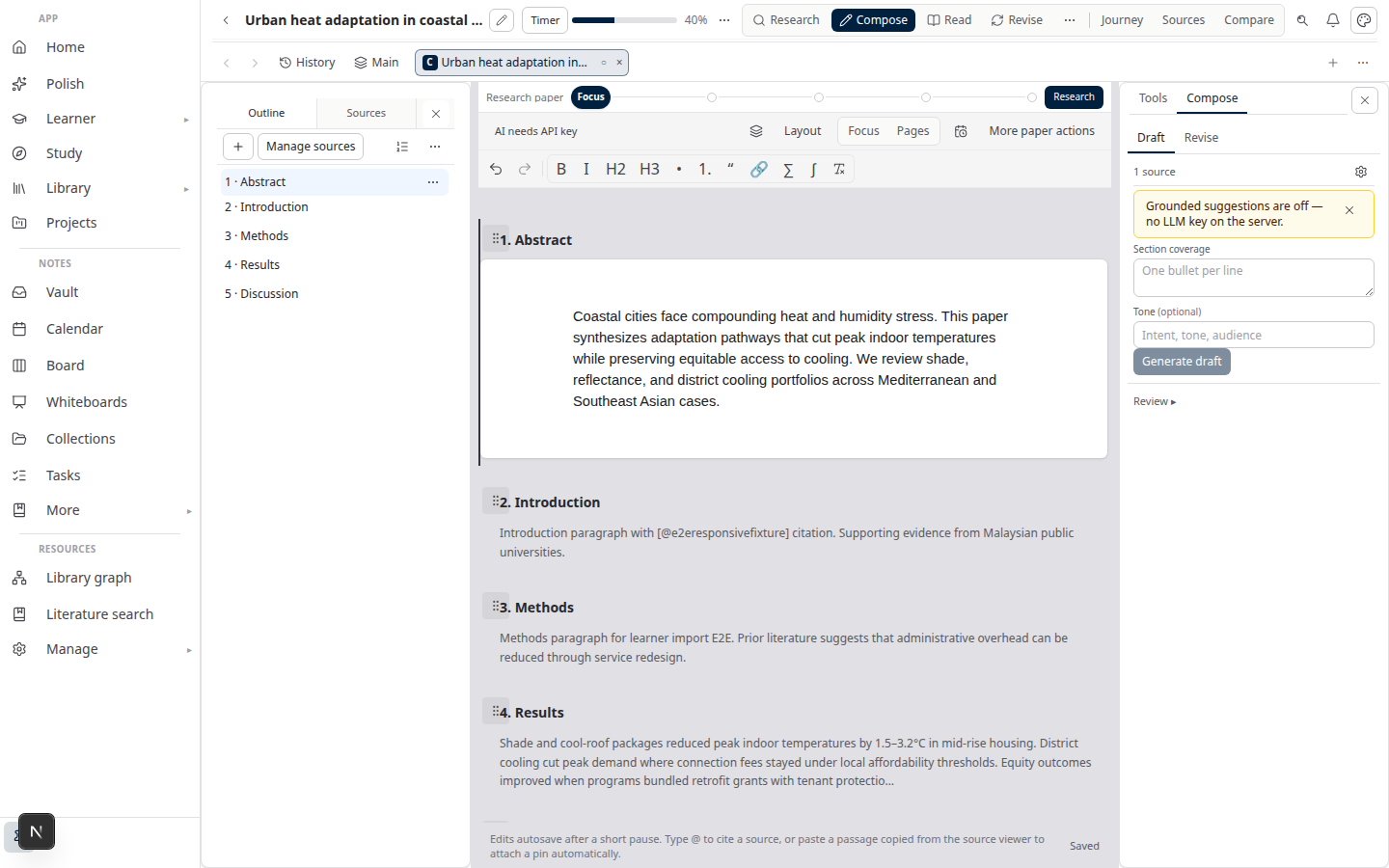
The conflict on paper sections
Academic manuscripts have a different failure mode than team wikis:
| Wiki editing | Manuscript editing |
|---|---|
| Fast iteration beats perfect audit | Export is a legal and academic artifact |
| Conflicts resolve by last edit | Citations must map to real sources |
| Comments suffice for review | Faculty wants a frozen chapter file |
Realtime co-edit on every paragraph makes it hard to answer: “Which version did we submit?” and “Which citation supported this sentence on export day?”
Lattuce uses approval gates — a section exports only when an author marks it approved after citation checks.
What ships today
| Surface | Collaboration model |
|---|---|
| Paper sections | Draft → citation check → approve → export |
| Household sharing | Shared library and papers within a household account |
| Translation | Segment review in collaborative translation editor |
| Notes / whiteboards | Household editing with default-on realtime collab, presence, and REST/offline fallback — not paper sections |
Workflow: Sources to DOCX.
Household realtime collab (notes and whiteboards)
Lattuce ships realtime collaboration on notes and whiteboards inside a household — see ADR 0030 on CRDT collab (COLLAB_CRDT_ENABLED=0 is the operator rollback to REST/offline sync). Even with live notes:
- Paper sections keep approval gates — export integrity is non-negotiable
- Org-wide facilitation (Miro Engage scale) stays out of scope
Do not expect Overleaf-style simultaneous LaTeX editing in Writer — LaTeX is an export path, not the primary canvas.
What we defer
| Deferred | Why |
|---|---|
| Realtime co-edit on approved paper sections | Breaks export audit trail |
| Org-wide team wiki replacement | Notion complement — why not replace Notion |
| “Google Docs but with AI” positioning | We defend grounded compose, not generic block chat |
When to use which tool
| Use Google Docs / Notion when… | Use Lattuce when… |
|---|---|
| Co-authors edit prose live in one doc | Sections need citation verification before export |
| Comments and suggestions are enough | You run literature missions then compose |
| No bibliography integrity gate | Word export must match attached library |
Fair comparison: Google Docs vs Lattuce.
Bottom line
Realtime co-edit wins speed on shared blocks. Section approval wins trust on submitted manuscripts. Lattuce picks the second because that is what graduate authors actually get graded on.
Related reading
Bahasa Melayu: Mengapa kelulusan seksyen mengatasi suntingan serentak untuk kertas akademik