Loading home
Loading home
Skip to content
Blog
  1. Blog
  2. /
  3. Workflow guides
  4. /
  5. Research missions in Lattuce — structured synthesis with evidence export

December 19, 2026 · Workflow guides

Research missions in Lattuce — structured synthesis with evidence export

Use Writer research missions for literature review and evidence export — reviewable output before you compose sections.

  • guide
  • writer
  • missions
  • research
  • seo
LanguageEnglishBahasa Melayu

Research missions are structured jobs over your corpus on lattuce.app. They produce synthesis and bibliography you can audit before you draft prose in Writer — not a one-shot chat answer you cannot verify.

For in-app help, ask the product assistant about Literature review with real references (help doc writer-research).
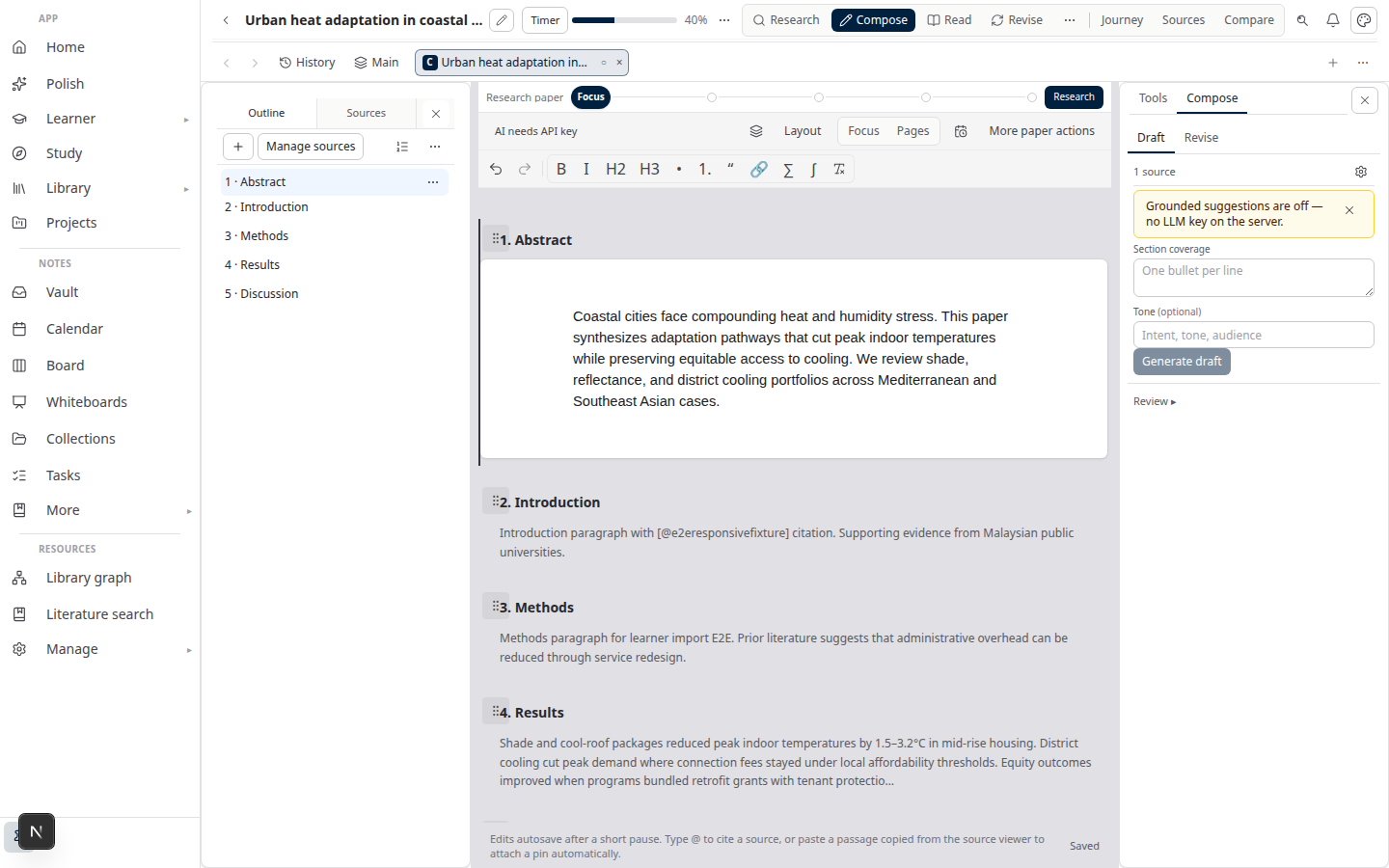
Lattuce Writer — from sources to cited draft

Who this is for

You are…Missions help when…
Graduate authorYou need an evidence matrix before writing chapter 2
PIYou want reviewable synthesis, not opaque AI summaries
Topic-first researcherYour library is thin but your question is clear

What missions are

A mission is a multi-step job with a template, timeline, and export surfaces:

TemplateWhat it doesPrerequisites
Literature discoverySearch catalogs, rank candidates for approvalResearch plan or manual start
Literature discovery + ingestDiscovery plus open-access PDF fetchOperator OA email configured
Literature reviewSynthesize attached, ready sourcesSources attached to the paper

Steps run asynchronously — large jobs may take tens of minutes. Watch the mission timeline; a stale warning after ~5 minutes idle is not always a failure.

Create a literature review mission

  1. Open your paper at lattuce.app.
  2. Attach library sources in the left pane — each must show ready.
  3. Go to Research → Missions → New mission.
  4. Choose Literature review.
  5. Wait for completion; open the synthesis report and evidence matrix.

If you have no sources yet, run literature discovery first (from the research plan or Missions), approve attachments, then start the review mission.

Review and approve mission output

Before you treat mission output as canon:

  1. Read the synthesis report — does it match your scope?
  2. Scan the evidence matrix — are the right papers represented?
  3. Approve pending source attachments the discovery mission proposed.
  4. Export to vault if you want a long-form note in your Research agents folder.
  5. Download export.md or export.bib if you need files outside Lattuce.

Do not skip human review. Missions accelerate reading; they do not replace your judgment.

Compose from synthesis

  1. In the completed mission panel, click Compose from synthesis.
  2. Writer opens with grounded starting text and cite chips tied to attached sources.
  3. Edit, run citation checks, and move sections toward approval.

Full pipeline through Word export: Sources to DOCX in Lattuce.

Evidence export

ExportFormatUse case
Mission panel download.mdHandoff to a co-author or external editor
Mission panel download.bibImport into Zotero (Zotero guide)
Export to vaultNote in Research agentsLong-term reference beside other research notes
Compose from synthesisWriter sectionsManuscript drafting

Opt-in bibliographic write-back (ZOTERO_WRITEBACK=1) can create or link items in Zotero from Library or a paper’s cited references. BibTeX export remains available for manual import.

Related reading

  • Literature review with Lattuce
  • Sources to DOCX in Lattuce
  • Elicit vs Lattuce — when corpus-scale screening stays in Elicit

Bahasa Melayu: Misi penyelidikan dalam Lattuce — sintesis berstruktur dengan eksport bukti

PreviousBYOS on Lattuce — bring your own storageNextUse Lattuce from Cursor and Claude — your research in your IDE

Workflow guides

  1. 1. Where you can use Lattuce today — cloud, Windows, and Android
  2. 2. Lattuce at lattuce.app is in alpha — what that means for you
  3. 3. Try Lattuce without signing up — interactive demos at lattuce.app/try
  4. 4. Leaving Lattuce cleanly — try first, delete when you need to
  5. 5. Literature review with Lattuce — from search to a cited Word file
  6. 6. Study vs Learner in Lattuce — exam prep or language learning?
  7. 7. Thesis format check in Lattuce — upload Word, fix layout, verify before you submit
  8. 8. BYOK on Lattuce — bring your own AI keys
  9. 9. Sources to DOCX in Lattuce — end-to-end manuscript workflow
  10. 10. BYOS on Lattuce — bring your own storage
  11. You are here11. Research missions in Lattuce — structured synthesis with evidence export
  12. 12. Use Lattuce from Cursor and Claude — your research in your IDE
  13. 13. Source Digest in Lattuce Study — audio, tables, mind maps, and flashcards
  14. 14. Workspace Ask for a household lab — grounded Q&A over your vault
  15. 15. Query canvas in Lattuce — live boards from your notes vault
  16. 16. Zotero to BibTeX in Lattuce — import, cite, and hand off bibliographies
  17. 17. Notes view layouts in Lattuce — Live, Read, and a sticky outline
  18. 18. Household admin's first week with Lattuce — checks and day-two tasks
  19. 19. Notes catalog layouts in Lattuce — Table, Board, Timeline, and saved views for your vault
  20. 20. Household billing and /pricing on Lattuce — transparent tiers for shared accounts
  21. 21. Version history in Lattuce — compare checkpoints, restore with confidence, and a three-tier workspace
  22. 22. Why Lattuce is not trying to replace Notion
  23. 23. Citation style preview in Lattuce — compare APA, MLA, Chicago, and more before you export
  24. 24. Research stack in 2026 — where Lattuce on lattuce.app sits
  25. 25. Supported citation formats in Lattuce — APA, Vancouver, Nature, and 27 more
  26. 26. Data residency for university labs in Malaysia
  27. 27. Why section approval beats realtime co-edit for academic papers
  28. 28. Research signals and feeds in Lattuce — headlines on home, sources in your library
  29. 29. Open catalogs Lattuce connects to — scholarly search, OA links, and books
  30. 30. How to export a cited thesis chapter to Word from Lattuce
  31. 31. Household Free vs Pro on lattuce.app — which plan fits your lab?
  32. 32. Try Lattuce Writer demo walkthrough — cited drafting without an account
  33. 33. Notes Live vs Read vs Split — when to use which in Lattuce
  34. 34. Citation styles for Malaysian universities in Lattuce Writer
  35. 35. From PDF highlight to cited paragraph in Lattuce
  36. 36. Leaving Notion pages in place — handoff checklist for Lattuce research
  37. 37. Alpha feedback — how to report useful bugs on lattuce.app

On this page

  1. Who this is for
  2. What missions are
  3. Create a literature review mission
  4. Review and approve mission output
  5. Compose from synthesis
  6. Evidence export
  7. Related reading

Explore Lattuce

Start writing, compare tools, or browse tutorials for your research stack.

Try LattuceTutorialsPlans

Subscribe to Workflow guides: RSS · Atom

← All posts
TermsPrivacyCookiesRefundsFAQContact[email protected]

© Lattuce

Skip to content
Blog
  1. Blog
  2. /
  3. Workflow guides
  4. /
  5. Research missions in Lattuce — structured synthesis with evidence export

December 19, 2026 · Workflow guides

Research missions in Lattuce — structured synthesis with evidence export

Use Writer research missions for literature review and evidence export — reviewable output before you compose sections.

  • guide
  • writer
  • missions
  • research
  • seo
LanguageEnglishBahasa Melayu

Research missions are structured jobs over your corpus on lattuce.app. They produce synthesis and bibliography you can audit before you draft prose in Writer — not a one-shot chat answer you cannot verify.

For in-app help, ask the product assistant about Literature review with real references (help doc writer-research).

Lattuce Writer — from sources to cited draft

Who this is for

You are…Missions help when…
Graduate authorYou need an evidence matrix before writing chapter 2
PIYou want reviewable synthesis, not opaque AI summaries
Topic-first researcherYour library is thin but your question is clear

What missions are

A mission is a multi-step job with a template, timeline, and export surfaces:

TemplateWhat it doesPrerequisites
Literature discoverySearch catalogs, rank candidates for approvalResearch plan or manual start
Literature discovery + ingestDiscovery plus open-access PDF fetchOperator OA email configured
Literature reviewSynthesize attached, ready sourcesSources attached to the paper

Steps run asynchronously — large jobs may take tens of minutes. Watch the mission timeline; a stale warning after ~5 minutes idle is not always a failure.

Create a literature review mission

  1. Open your paper at lattuce.app.
  2. Attach library sources in the left pane — each must show ready.
  3. Go to Research → Missions → New mission.
  4. Choose Literature review.
  5. Wait for completion; open the synthesis report and evidence matrix.

If you have no sources yet, run literature discovery first (from the research plan or Missions), approve attachments, then start the review mission.

Review and approve mission output

Before you treat mission output as canon:

  1. Read the synthesis report — does it match your scope?
  2. Scan the evidence matrix — are the right papers represented?
  3. Approve pending source attachments the discovery mission proposed.
  4. Export to vault if you want a long-form note in your Research agents folder.
  5. Download export.md or export.bib if you need files outside Lattuce.

Do not skip human review. Missions accelerate reading; they do not replace your judgment.

Compose from synthesis

  1. In the completed mission panel, click Compose from synthesis.
  2. Writer opens with grounded starting text and cite chips tied to attached sources.
  3. Edit, run citation checks, and move sections toward approval.

Full pipeline through Word export: Sources to DOCX in Lattuce.

Evidence export

ExportFormatUse case
Mission panel download.mdHandoff to a co-author or external editor
Mission panel download.bibImport into Zotero (Zotero guide)
Export to vaultNote in Research agentsLong-term reference beside other research notes
Compose from synthesisWriter sectionsManuscript drafting

Opt-in bibliographic write-back (ZOTERO_WRITEBACK=1) can create or link items in Zotero from Library or a paper’s cited references. BibTeX export remains available for manual import.

Related reading

  • Literature review with Lattuce
  • Sources to DOCX in Lattuce
  • Elicit vs Lattuce — when corpus-scale screening stays in Elicit

Bahasa Melayu: Misi penyelidikan dalam Lattuce — sintesis berstruktur dengan eksport bukti

PreviousBYOS on Lattuce — bring your own storageNextUse Lattuce from Cursor and Claude — your research in your IDE

Workflow guides

  1. 1. Where you can use Lattuce today — cloud, Windows, and Android
  2. 2. Lattuce at lattuce.app is in alpha — what that means for you
  3. 3. Try Lattuce without signing up — interactive demos at lattuce.app/try
  4. 4. Leaving Lattuce cleanly — try first, delete when you need to
  5. 5. Literature review with Lattuce — from search to a cited Word file
  6. 6. Study vs Learner in Lattuce — exam prep or language learning?
  7. 7. Thesis format check in Lattuce — upload Word, fix layout, verify before you submit
  8. 8. BYOK on Lattuce — bring your own AI keys
  9. 9. Sources to DOCX in Lattuce — end-to-end manuscript workflow
  10. 10. BYOS on Lattuce — bring your own storage
  11. You are here11. Research missions in Lattuce — structured synthesis with evidence export
  12. 12. Use Lattuce from Cursor and Claude — your research in your IDE
  13. 13. Source Digest in Lattuce Study — audio, tables, mind maps, and flashcards
  14. 14. Workspace Ask for a household lab — grounded Q&A over your vault
  15. 15. Query canvas in Lattuce — live boards from your notes vault
  16. 16. Zotero to BibTeX in Lattuce — import, cite, and hand off bibliographies
  17. 17. Notes view layouts in Lattuce — Live, Read, and a sticky outline
  18. 18. Household admin's first week with Lattuce — checks and day-two tasks
  19. 19. Notes catalog layouts in Lattuce — Table, Board, Timeline, and saved views for your vault
  20. 20. Household billing and /pricing on Lattuce — transparent tiers for shared accounts
  21. 21. Version history in Lattuce — compare checkpoints, restore with confidence, and a three-tier workspace
  22. 22. Why Lattuce is not trying to replace Notion
  23. 23. Citation style preview in Lattuce — compare APA, MLA, Chicago, and more before you export
  24. 24. Research stack in 2026 — where Lattuce on lattuce.app sits
  25. 25. Supported citation formats in Lattuce — APA, Vancouver, Nature, and 27 more
  26. 26. Data residency for university labs in Malaysia
  27. 27. Why section approval beats realtime co-edit for academic papers
  28. 28. Research signals and feeds in Lattuce — headlines on home, sources in your library
  29. 29. Open catalogs Lattuce connects to — scholarly search, OA links, and books
  30. 30. How to export a cited thesis chapter to Word from Lattuce
  31. 31. Household Free vs Pro on lattuce.app — which plan fits your lab?
  32. 32. Try Lattuce Writer demo walkthrough — cited drafting without an account
  33. 33. Notes Live vs Read vs Split — when to use which in Lattuce
  34. 34. Citation styles for Malaysian universities in Lattuce Writer
  35. 35. From PDF highlight to cited paragraph in Lattuce
  36. 36. Leaving Notion pages in place — handoff checklist for Lattuce research
  37. 37. Alpha feedback — how to report useful bugs on lattuce.app

On this page

  1. Who this is for
  2. What missions are
  3. Create a literature review mission
  4. Review and approve mission output
  5. Compose from synthesis
  6. Evidence export
  7. Related reading

Explore Lattuce

Start writing, compare tools, or browse tutorials for your research stack.

Try LattuceTutorialsPlans

Subscribe to Workflow guides: RSS · Atom

← All posts
TermsPrivacyCookiesRefundsFAQContact[email protected]

© Lattuce