Loading home
Loading home
Skip to content
Blog
  1. Blog
  2. /
  3. Tool comparisons
  4. /
  5. Consensus vs Lattuce — research Q&A search or cited writing pipeline?

May 22, 2027 · Tool comparisons

Consensus vs Lattuce — research Q&A search or cited writing pipeline?

Consensus is research Q&A over published papers. Lattuce is attach your PDFs → missions → cited draft → Word. Scout, then write.

  • comparison
  • consensus
  • literature-review
  • research
  • seo
LanguageEnglishBahasa Melayu

Consensus is an AI research Q&A search over a large index of published papers: ask a literature question, read a findings summary, and see which studies lean yes, no, or mixed. Lattuce at lattuce.app is a cited writing pipeline — attach the PDFs you keep, run a reviewable mission, compose with citation checks, approve sections, and export Word.

In short: use Consensus to scout what published research already says. Use Lattuce when those papers must become a manuscript you can defend and submit.
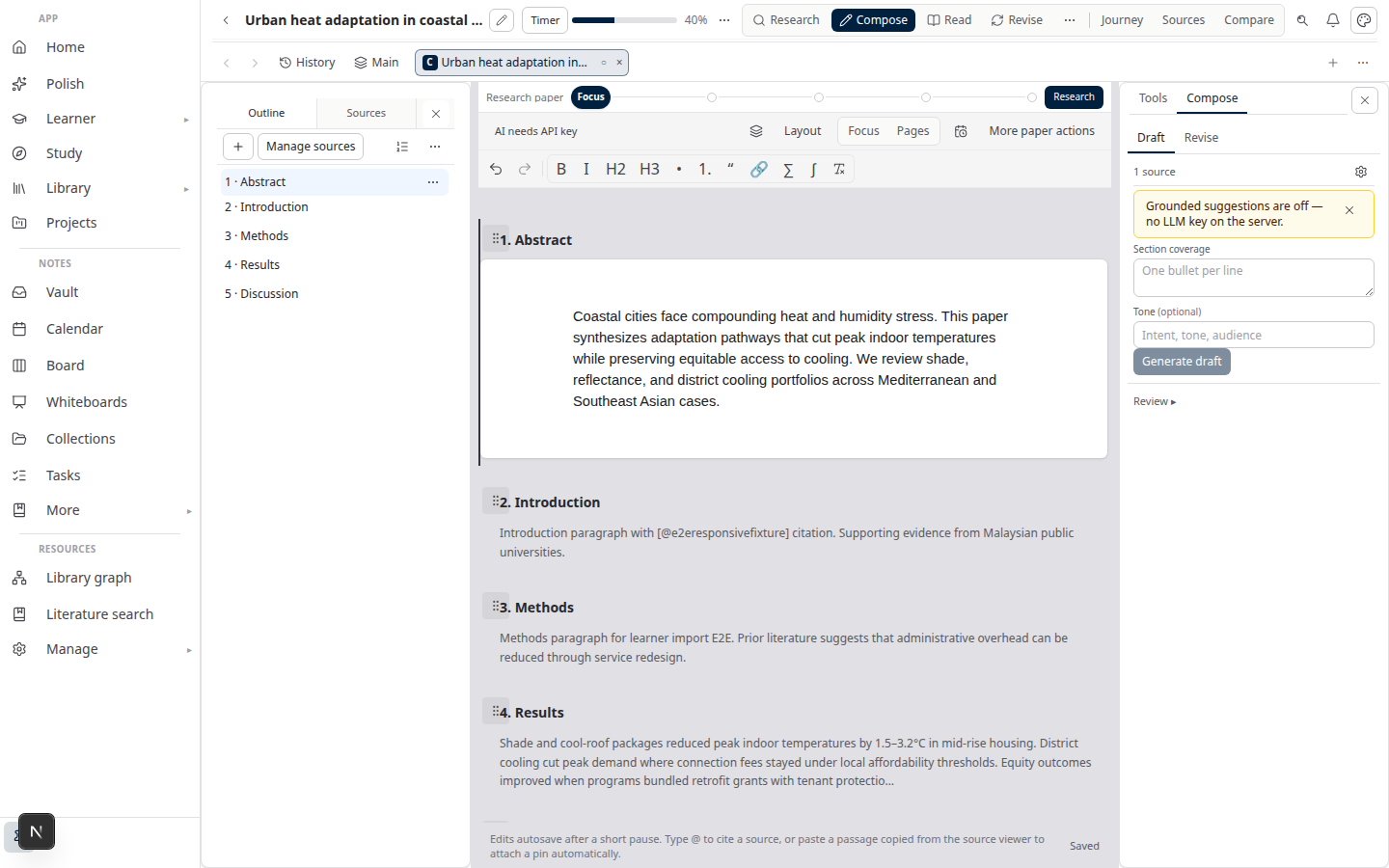
Lattuce Writer — from sources to cited draft

Quick comparison

ConsensusLattuce
Core jobLiterature Q&A and findings summariesResearch + writing pipeline on your library
CorpusTheir index of 220M+ peer-reviewed papersPDFs, sources, and notes you attach
Standout featureConsensus Meter on yes/no questionsWriter with citation checks → Word export
Literature reviewFast scan of published findingsMissions with a synthesis report and evidence matrix
Manuscript drafting—Compose from synthesis → section approval → Word
Notes / vaultLists to save papersNotes vault, whiteboards, Workspace Ask
Study artifactsAsk Paper / study snapshots in searchAudio, tables, mind maps, flashcards from your collections
Translation—Collaborative translation for multilingual papers
SetupVendor SaaS — sign up and askSign up at lattuce.app; optional your own AI keys

When to use which

NeedUse
Ask “what does the literature say?” and get an answer in minutesConsensus
See yes / no / mixed lean across the top papers on a questionConsensus
Read a findings summary before you have a local PDF pileConsensus
Scout a topic and export a shortlist to a reference managerConsensus
Attach the PDFs you already own and synthesize those filesLattuce
Audit an evidence matrix before anyone drafts proseLattuce
Compose cited sections, run citation checks, and approve themLattuce
Export an approved Word file with a real bibliographyLattuce
Turn a reading pile into study artifacts, then keep writingLattuce
Translate a paper collaboratively with colleaguesLattuce

A common pattern: start in Consensus to scout, then bring the shortlist into Lattuce to write. Consensus helps you see the published map; Lattuce helps you finish the chapter.

For systematic-review screening at corpus scale, see Elicit vs Lattuce. For the combined answer-engine view, see Elicit and Consensus vs Lattuce.

What Consensus still wins

  • Speed to an answer — type a research question and get a literature Q&A with paper-backed findings. There is no library to build first.
  • Findings summaries — Pro-style synthesis over the top search hits is built for “what did these papers find?”, not for drafting your own sections.
  • Consensus Meter — on yes/no questions, Consensus classifies the most relevant papers as yes, no, possibly, or mixed. Lattuce does not try to visualize field-wide agreement on a hosted index.
  • Corpus scale — a search index of 220M+ peer-reviewed papers is a different job from a workspace over files you attach. Lattuce catalogs and missions help you find and approve sources; they do not replace Consensus-scale Q&A.
  • Zero writing-pipeline setup — sign up, ask, skim. No paper project, no attachment gate, no section approval.

Those strengths are real. They are also why Consensus is a scout, not a submit path. A findings summary is not a cited Word manuscript. Treat the meter and the snippets as a map of leads — then read the papers you will actually cite.

What Lattuce wins

  • Attach your PDFs → missions → compose → approve → Word — that is the job Consensus does not do. You keep the files, review the synthesis, draft against those sources, and export a bibliography tied to the library.
  • Literature missions with an evidence matrix — a literature review mission synthesizes attached, ready PDFs into a report you can audit before anyone writes prose. See Research missions in Lattuce.
  • Compose from synthesis — Writer opens with grounded starting text and cite chips from sources on the paper, not names remembered from a search thread.
  • Citation checks and section approval — claims are checked against your library; sections move to approved before export.
  • Approved Word export with real references — the result is a DOCX with a bibliography, not a copied chat answer. Walk the pipeline in Sources to DOCX in Lattuce.
  • A durable library — highlights and notes stay with the PDFs you keep, across projects. The author path is in Literature review with Lattuce.
  • Study digest over your collections — audio, tables, mind maps, and flashcards from files you own, then a path into Writer when the digest should become a cited chapter.
  • Household account and optional your own AI keys — one research workspace for a family, small lab, or thesis group; configure provider keys in settings if you prefer.
  • Collaborative translation — multilingual papers with a shared translation workflow when a lab works across languages.

Honest limits: Lattuce does not answer “what does all published science say?” at Consensus index scale, does not show a yes/no consensus meter over a hosted corpus, and does not real-time co-edit paper sections. Approval and export integrity come first. Keep Consensus (or Elicit) for scouting; keep a reference manager for the library of record if you already have one.

Using both together

These tools complement each other. A practical split:

  1. Scout in Consensus — ask the literature question, read the findings summary, check the meter if the question is yes/no, and save the papers that matter.
  2. Bring the shortlist to Lattuce — upload or attach the PDFs, wait until each source shows ready, and run a literature review mission.
  3. Write in Lattuce — compose from synthesis, edit, run citation checks, approve sections, and export Word.

Discovery at Consensus scale, durability in your own workspace. You do not have to pick only one.

Bottom line

Choose Consensus when you need research Q&A search: a fast, paper-backed answer and a findings summary before you own the PDFs. Choose Lattuce when the work must end as a cited writing pipeline — attach your sources, review the mission, compose, approve, and export Word. Many researchers will scout in Consensus and write in Lattuce.

See also: Elicit and Consensus vs Lattuce · Elicit vs Lattuce · Literature review with Lattuce · Research missions in Lattuce · Lattuce vs research apps

Bahasa Melayu: Consensus vs Lattuce — carian Q&A penyelidikan atau talian paip penulisan bersitasi?

PreviousTypst.app and Overleaf vs Lattuce — typesetting clouds or grounded Word export?NextPerplexity Academic vs Lattuce missions — web search chat or library-grounded synthesis?

Tool comparisons

  1. 1. Notion vs Lattuce — which research tool fits your workflow?
  2. 2. Using Lattuce alongside Notion
  3. 3. Lattuce vs research and team apps
  4. 4. Obsidian vs Lattuce — notes vault or full research workspace?
  5. 5. NotebookLM vs Lattuce — quick digest or full research workflow?
  6. 6. Heptabase vs Lattuce — visual thinking or cited academic writing?
  7. 7. Lattuce + Zotero — import, cite, and export without leaving your library
  8. 8. Fabric vs Lattuce — AI second brain or cited academic writing?
  9. 9. Overleaf vs Lattuce — LaTeX collaboration or grounded Word export pipeline?
  10. 10. Scrivener vs Lattuce — long-form structure vs research pipeline
  11. 11. Elicit and Consensus vs Lattuce — answer engines vs grounded research pipeline
  12. 12. AFFiNE vs Lattuce — doc-canvas fusion vs academic research layer
  13. 13. Logseq and Roam vs Lattuce — daily notes vs publish pipeline
  14. 14. Google Docs vs Lattuce — co-authored drafts vs citation-verified export
  15. 15. Elicit vs Lattuce — literature search or full research pipeline?
  16. 16. ChatGPT vs Lattuce for literature review — brainstorm or cited Word export?
  17. 17. Paperpile and Mendeley vs Lattuce — reference managers or writing pipeline?
  18. 18. Typst.app and Overleaf vs Lattuce — typesetting clouds or grounded Word export?
  19. You are here19. Consensus vs Lattuce — research Q&A search or cited writing pipeline?
  20. 20. Perplexity Academic vs Lattuce missions — web search chat or library-grounded synthesis?

On this page

  1. Quick comparison
  2. When to use which
  3. What Consensus still wins
  4. What Lattuce wins
  5. Using both together
  6. Bottom line

Explore Lattuce

Start writing, compare tools, or browse tutorials for your research stack.

Try LattuceTutorialsPlans

Subscribe to Tool comparisons: RSS · Atom

← All posts
TermsPrivacyCookiesRefundsFAQContact[email protected]

© Lattuce

Skip to content
Blog
  1. Blog
  2. /
  3. Tool comparisons
  4. /
  5. Consensus vs Lattuce — research Q&A search or cited writing pipeline?

May 22, 2027 · Tool comparisons

Consensus vs Lattuce — research Q&A search or cited writing pipeline?

Consensus is research Q&A over published papers. Lattuce is attach your PDFs → missions → cited draft → Word. Scout, then write.

  • comparison
  • consensus
  • literature-review
  • research
  • seo
LanguageEnglishBahasa Melayu

Consensus is an AI research Q&A search over a large index of published papers: ask a literature question, read a findings summary, and see which studies lean yes, no, or mixed. Lattuce at lattuce.app is a cited writing pipeline — attach the PDFs you keep, run a reviewable mission, compose with citation checks, approve sections, and export Word.

In short: use Consensus to scout what published research already says. Use Lattuce when those papers must become a manuscript you can defend and submit.

Lattuce Writer — from sources to cited draft

Quick comparison

ConsensusLattuce
Core jobLiterature Q&A and findings summariesResearch + writing pipeline on your library
CorpusTheir index of 220M+ peer-reviewed papersPDFs, sources, and notes you attach
Standout featureConsensus Meter on yes/no questionsWriter with citation checks → Word export
Literature reviewFast scan of published findingsMissions with a synthesis report and evidence matrix
Manuscript drafting—Compose from synthesis → section approval → Word
Notes / vaultLists to save papersNotes vault, whiteboards, Workspace Ask
Study artifactsAsk Paper / study snapshots in searchAudio, tables, mind maps, flashcards from your collections
Translation—Collaborative translation for multilingual papers
SetupVendor SaaS — sign up and askSign up at lattuce.app; optional your own AI keys

When to use which

NeedUse
Ask “what does the literature say?” and get an answer in minutesConsensus
See yes / no / mixed lean across the top papers on a questionConsensus
Read a findings summary before you have a local PDF pileConsensus
Scout a topic and export a shortlist to a reference managerConsensus
Attach the PDFs you already own and synthesize those filesLattuce
Audit an evidence matrix before anyone drafts proseLattuce
Compose cited sections, run citation checks, and approve themLattuce
Export an approved Word file with a real bibliographyLattuce
Turn a reading pile into study artifacts, then keep writingLattuce
Translate a paper collaboratively with colleaguesLattuce

A common pattern: start in Consensus to scout, then bring the shortlist into Lattuce to write. Consensus helps you see the published map; Lattuce helps you finish the chapter.

For systematic-review screening at corpus scale, see Elicit vs Lattuce. For the combined answer-engine view, see Elicit and Consensus vs Lattuce.

What Consensus still wins

  • Speed to an answer — type a research question and get a literature Q&A with paper-backed findings. There is no library to build first.
  • Findings summaries — Pro-style synthesis over the top search hits is built for “what did these papers find?”, not for drafting your own sections.
  • Consensus Meter — on yes/no questions, Consensus classifies the most relevant papers as yes, no, possibly, or mixed. Lattuce does not try to visualize field-wide agreement on a hosted index.
  • Corpus scale — a search index of 220M+ peer-reviewed papers is a different job from a workspace over files you attach. Lattuce catalogs and missions help you find and approve sources; they do not replace Consensus-scale Q&A.
  • Zero writing-pipeline setup — sign up, ask, skim. No paper project, no attachment gate, no section approval.

Those strengths are real. They are also why Consensus is a scout, not a submit path. A findings summary is not a cited Word manuscript. Treat the meter and the snippets as a map of leads — then read the papers you will actually cite.

What Lattuce wins

  • Attach your PDFs → missions → compose → approve → Word — that is the job Consensus does not do. You keep the files, review the synthesis, draft against those sources, and export a bibliography tied to the library.
  • Literature missions with an evidence matrix — a literature review mission synthesizes attached, ready PDFs into a report you can audit before anyone writes prose. See Research missions in Lattuce.
  • Compose from synthesis — Writer opens with grounded starting text and cite chips from sources on the paper, not names remembered from a search thread.
  • Citation checks and section approval — claims are checked against your library; sections move to approved before export.
  • Approved Word export with real references — the result is a DOCX with a bibliography, not a copied chat answer. Walk the pipeline in Sources to DOCX in Lattuce.
  • A durable library — highlights and notes stay with the PDFs you keep, across projects. The author path is in Literature review with Lattuce.
  • Study digest over your collections — audio, tables, mind maps, and flashcards from files you own, then a path into Writer when the digest should become a cited chapter.
  • Household account and optional your own AI keys — one research workspace for a family, small lab, or thesis group; configure provider keys in settings if you prefer.
  • Collaborative translation — multilingual papers with a shared translation workflow when a lab works across languages.

Honest limits: Lattuce does not answer “what does all published science say?” at Consensus index scale, does not show a yes/no consensus meter over a hosted corpus, and does not real-time co-edit paper sections. Approval and export integrity come first. Keep Consensus (or Elicit) for scouting; keep a reference manager for the library of record if you already have one.

Using both together

These tools complement each other. A practical split:

  1. Scout in Consensus — ask the literature question, read the findings summary, check the meter if the question is yes/no, and save the papers that matter.
  2. Bring the shortlist to Lattuce — upload or attach the PDFs, wait until each source shows ready, and run a literature review mission.
  3. Write in Lattuce — compose from synthesis, edit, run citation checks, approve sections, and export Word.

Discovery at Consensus scale, durability in your own workspace. You do not have to pick only one.

Bottom line

Choose Consensus when you need research Q&A search: a fast, paper-backed answer and a findings summary before you own the PDFs. Choose Lattuce when the work must end as a cited writing pipeline — attach your sources, review the mission, compose, approve, and export Word. Many researchers will scout in Consensus and write in Lattuce.

See also: Elicit and Consensus vs Lattuce · Elicit vs Lattuce · Literature review with Lattuce · Research missions in Lattuce · Lattuce vs research apps

Bahasa Melayu: Consensus vs Lattuce — carian Q&A penyelidikan atau talian paip penulisan bersitasi?

PreviousTypst.app and Overleaf vs Lattuce — typesetting clouds or grounded Word export?NextPerplexity Academic vs Lattuce missions — web search chat or library-grounded synthesis?

Tool comparisons

  1. 1. Notion vs Lattuce — which research tool fits your workflow?
  2. 2. Using Lattuce alongside Notion
  3. 3. Lattuce vs research and team apps
  4. 4. Obsidian vs Lattuce — notes vault or full research workspace?
  5. 5. NotebookLM vs Lattuce — quick digest or full research workflow?
  6. 6. Heptabase vs Lattuce — visual thinking or cited academic writing?
  7. 7. Lattuce + Zotero — import, cite, and export without leaving your library
  8. 8. Fabric vs Lattuce — AI second brain or cited academic writing?
  9. 9. Overleaf vs Lattuce — LaTeX collaboration or grounded Word export pipeline?
  10. 10. Scrivener vs Lattuce — long-form structure vs research pipeline
  11. 11. Elicit and Consensus vs Lattuce — answer engines vs grounded research pipeline
  12. 12. AFFiNE vs Lattuce — doc-canvas fusion vs academic research layer
  13. 13. Logseq and Roam vs Lattuce — daily notes vs publish pipeline
  14. 14. Google Docs vs Lattuce — co-authored drafts vs citation-verified export
  15. 15. Elicit vs Lattuce — literature search or full research pipeline?
  16. 16. ChatGPT vs Lattuce for literature review — brainstorm or cited Word export?
  17. 17. Paperpile and Mendeley vs Lattuce — reference managers or writing pipeline?
  18. 18. Typst.app and Overleaf vs Lattuce — typesetting clouds or grounded Word export?
  19. You are here19. Consensus vs Lattuce — research Q&A search or cited writing pipeline?
  20. 20. Perplexity Academic vs Lattuce missions — web search chat or library-grounded synthesis?

On this page

  1. Quick comparison
  2. When to use which
  3. What Consensus still wins
  4. What Lattuce wins
  5. Using both together
  6. Bottom line

Explore Lattuce

Start writing, compare tools, or browse tutorials for your research stack.

Try LattuceTutorialsPlans

Subscribe to Tool comparisons: RSS · Atom

← All posts
TermsPrivacyCookiesRefundsFAQContact[email protected]

© Lattuce