Loading home
Loading home
Skip to content
Blog
  1. Blog
  2. /
  3. Tool comparisons
  4. /
  5. Elicit and Consensus vs Lattuce — answer engines vs grounded research pipeline

November 14, 2026 · Tool comparisons

Elicit and Consensus vs Lattuce — answer engines vs grounded research pipeline

AI literature tools summarize papers fast. Lattuce keeps discovery, synthesis, and writing tied to your library with citation verification and Word export.

  • comparison
  • elicit
  • consensus
  • literature-review
  • seo

Elicit and Consensus are AI answer engines for papers — find studies, build tables, and summarize findings quickly in the browser. Lattuce is a full research workspace at lattuce.app where discovery leads to cited sections and Word export, not just chat answers.

In short: use Elicit or Consensus for fast paper Q&A; use Lattuce when you need a durable manuscript pipeline on your own library.
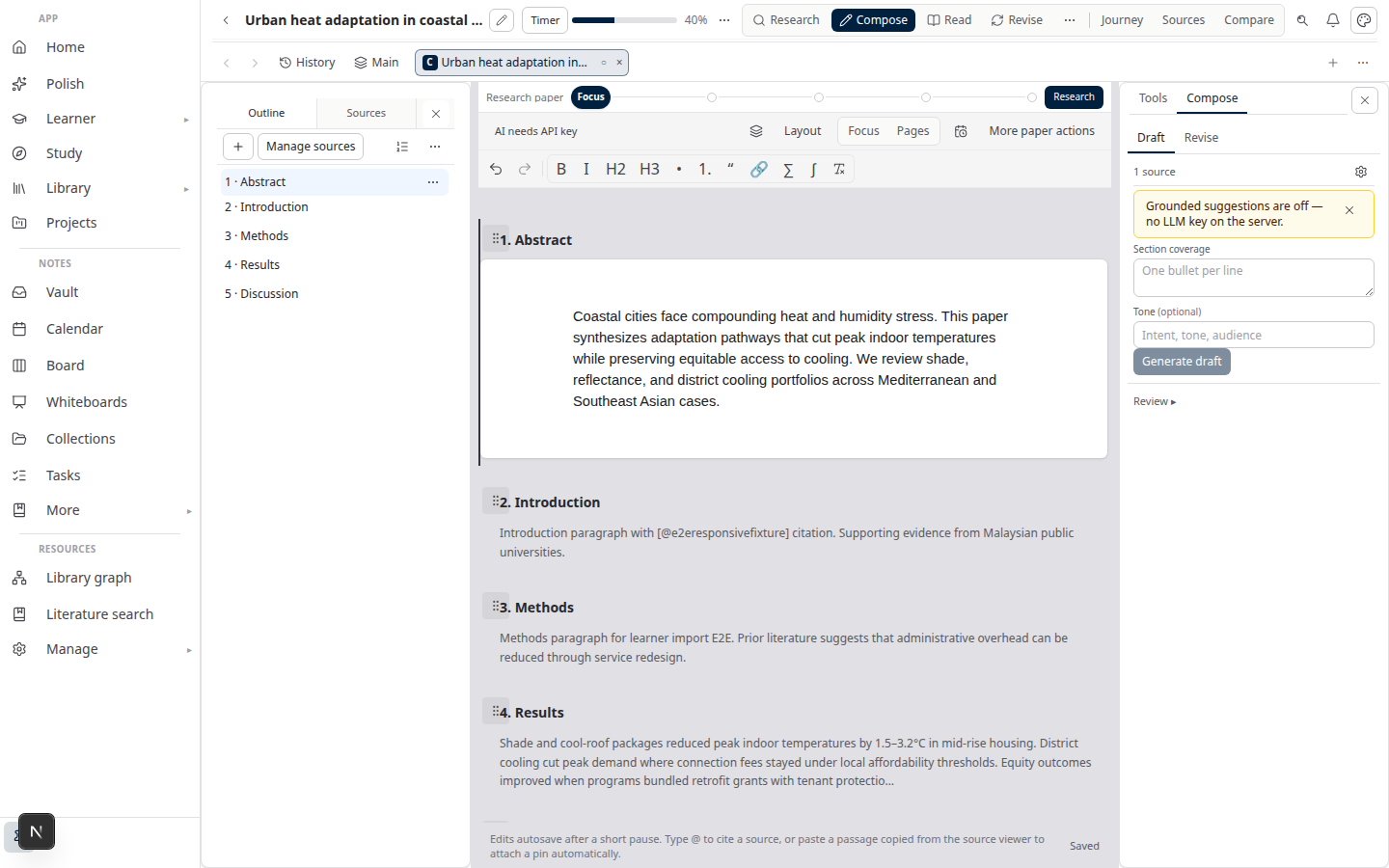
Lattuce Writer — from sources to cited draft

Quick comparison

Elicit / ConsensusLattuce
Core jobFind and summarize papers fastResearch + writing at lattuce.app
CorpusTheir indexes + your uploads (varies)Your PDF library and notes
OutputTables, chat answers, summariesSections with citation checks → Word
Literature reviewStrong for quick scansMissions with exported evidence
Notes / vaultLimitedNotes, graph, whiteboards
Study artifacts—Audio, tables, mind maps from collections
Translation—Collaborative translation for papers
Data locationVendor cloudYour household at lattuce.app

What answer engines do well

  • Speed — paper finding and comparison tables in minutes
  • Low setup — sign up and ask questions
  • Good for exploring a new topic before deep reading
  • Consensus-style evidence snippets with links to sources

Where Lattuce differs

  • Owned corpus — highlights and notes stay with your library
  • Research missions — reviewable exports before you draft
  • Writing with citation checks — not copy-paste from chat
  • Section approval then Word export with bibliography
  • Study digests — summaries tied to collections you keep
  • Notes and Ask across vault, library, and papers

Source Digest in Study

When you need audio summaries, mind maps, or flashcards from a reading pile, Lattuce Study builds artifacts from your uploaded PDFs — complementary to one-off Elicit tables. See Study source digest.

Bottom line

Choose Elicit or Consensus for fast discovery and tables. Choose Lattuce when the goal is a finished cited manuscript on lattuce.app — not just answers in a chat panel.

See also: Elicit vs Lattuce · NotebookLM vs Lattuce · Literature review with Lattuce

PreviousScrivener vs Lattuce — long-form structure vs research pipelineNextAFFiNE vs Lattuce — doc-canvas fusion vs academic research layer

Tool comparisons

  1. 1. Notion vs Lattuce — which research tool fits your workflow?
  2. 2. Using Lattuce alongside Notion
  3. 3. Lattuce vs research and team apps
  4. 4. Obsidian vs Lattuce — notes vault or full research workspace?
  5. 5. NotebookLM vs Lattuce — quick digest or full research workflow?
  6. 6. Heptabase vs Lattuce — visual thinking or cited academic writing?
  7. 7. Lattuce + Zotero — import, cite, and export without leaving your library
  8. 8. Fabric vs Lattuce — AI second brain or cited academic writing?
  9. 9. Overleaf vs Lattuce — LaTeX collaboration or grounded Word export pipeline?
  10. 10. Scrivener vs Lattuce — long-form structure vs research pipeline
  11. You are here11. Elicit and Consensus vs Lattuce — answer engines vs grounded research pipeline
  12. 12. AFFiNE vs Lattuce — doc-canvas fusion vs academic research layer
  13. 13. Logseq and Roam vs Lattuce — daily notes vs publish pipeline
  14. 14. Google Docs vs Lattuce — co-authored drafts vs citation-verified export
  15. 15. Elicit vs Lattuce — literature search or full research pipeline?
  16. 16. ChatGPT vs Lattuce for literature review — brainstorm or cited Word export?
  17. 17. Paperpile and Mendeley vs Lattuce — reference managers or writing pipeline?
  18. 18. Typst.app and Overleaf vs Lattuce — typesetting clouds or grounded Word export?
  19. 19. Consensus vs Lattuce — research Q&A search or cited writing pipeline?
  20. 20. Perplexity Academic vs Lattuce missions — web search chat or library-grounded synthesis?

On this page

  1. Quick comparison
  2. What answer engines do well
  3. Where Lattuce differs
  4. Source Digest in Study
  5. Bottom line

Explore Lattuce

Start writing, compare tools, or browse tutorials for your research stack.

Try LattuceTutorialsPlans

Subscribe to Tool comparisons: RSS · Atom

← All posts
TermsPrivacyCookiesRefundsFAQContact[email protected]

© Lattuce

Skip to content
Blog
  1. Blog
  2. /
  3. Tool comparisons
  4. /
  5. Elicit and Consensus vs Lattuce — answer engines vs grounded research pipeline

November 14, 2026 · Tool comparisons

Elicit and Consensus vs Lattuce — answer engines vs grounded research pipeline

AI literature tools summarize papers fast. Lattuce keeps discovery, synthesis, and writing tied to your library with citation verification and Word export.

  • comparison
  • elicit
  • consensus
  • literature-review
  • seo

Elicit and Consensus are AI answer engines for papers — find studies, build tables, and summarize findings quickly in the browser. Lattuce is a full research workspace at lattuce.app where discovery leads to cited sections and Word export, not just chat answers.

In short: use Elicit or Consensus for fast paper Q&A; use Lattuce when you need a durable manuscript pipeline on your own library.

Lattuce Writer — from sources to cited draft

Quick comparison

Elicit / ConsensusLattuce
Core jobFind and summarize papers fastResearch + writing at lattuce.app
CorpusTheir indexes + your uploads (varies)Your PDF library and notes
OutputTables, chat answers, summariesSections with citation checks → Word
Literature reviewStrong for quick scansMissions with exported evidence
Notes / vaultLimitedNotes, graph, whiteboards
Study artifacts—Audio, tables, mind maps from collections
Translation—Collaborative translation for papers
Data locationVendor cloudYour household at lattuce.app

What answer engines do well

  • Speed — paper finding and comparison tables in minutes
  • Low setup — sign up and ask questions
  • Good for exploring a new topic before deep reading
  • Consensus-style evidence snippets with links to sources

Where Lattuce differs

  • Owned corpus — highlights and notes stay with your library
  • Research missions — reviewable exports before you draft
  • Writing with citation checks — not copy-paste from chat
  • Section approval then Word export with bibliography
  • Study digests — summaries tied to collections you keep
  • Notes and Ask across vault, library, and papers

Source Digest in Study

When you need audio summaries, mind maps, or flashcards from a reading pile, Lattuce Study builds artifacts from your uploaded PDFs — complementary to one-off Elicit tables. See Study source digest.

Bottom line

Choose Elicit or Consensus for fast discovery and tables. Choose Lattuce when the goal is a finished cited manuscript on lattuce.app — not just answers in a chat panel.

See also: Elicit vs Lattuce · NotebookLM vs Lattuce · Literature review with Lattuce

PreviousScrivener vs Lattuce — long-form structure vs research pipelineNextAFFiNE vs Lattuce — doc-canvas fusion vs academic research layer

Tool comparisons

  1. 1. Notion vs Lattuce — which research tool fits your workflow?
  2. 2. Using Lattuce alongside Notion
  3. 3. Lattuce vs research and team apps
  4. 4. Obsidian vs Lattuce — notes vault or full research workspace?
  5. 5. NotebookLM vs Lattuce — quick digest or full research workflow?
  6. 6. Heptabase vs Lattuce — visual thinking or cited academic writing?
  7. 7. Lattuce + Zotero — import, cite, and export without leaving your library
  8. 8. Fabric vs Lattuce — AI second brain or cited academic writing?
  9. 9. Overleaf vs Lattuce — LaTeX collaboration or grounded Word export pipeline?
  10. 10. Scrivener vs Lattuce — long-form structure vs research pipeline
  11. You are here11. Elicit and Consensus vs Lattuce — answer engines vs grounded research pipeline
  12. 12. AFFiNE vs Lattuce — doc-canvas fusion vs academic research layer
  13. 13. Logseq and Roam vs Lattuce — daily notes vs publish pipeline
  14. 14. Google Docs vs Lattuce — co-authored drafts vs citation-verified export
  15. 15. Elicit vs Lattuce — literature search or full research pipeline?
  16. 16. ChatGPT vs Lattuce for literature review — brainstorm or cited Word export?
  17. 17. Paperpile and Mendeley vs Lattuce — reference managers or writing pipeline?
  18. 18. Typst.app and Overleaf vs Lattuce — typesetting clouds or grounded Word export?
  19. 19. Consensus vs Lattuce — research Q&A search or cited writing pipeline?
  20. 20. Perplexity Academic vs Lattuce missions — web search chat or library-grounded synthesis?

On this page

  1. Quick comparison
  2. What answer engines do well
  3. Where Lattuce differs
  4. Source Digest in Study
  5. Bottom line

Explore Lattuce

Start writing, compare tools, or browse tutorials for your research stack.

Try LattuceTutorialsPlans

Subscribe to Tool comparisons: RSS · Atom

← All posts
TermsPrivacyCookiesRefundsFAQContact[email protected]

© Lattuce