ChatGPT vs Lattuce for literature review — brainstorm or cited Word export?
ChatGPT vs Lattuce for literature review — brainstorm in chat, or cite your PDFs and export Word.
ChatGPT is a conversational assistant: brainstorm a topic, sketch an outline, polish sentences, or talk through a literature question with no research setup. Lattuce at lattuce.app is a cloud research-and-writing layer — PDF library, research missions, citation checks, section approval, and Word export with real references.
In short: use ChatGPT for early academic literature review ideation. Use Lattuce when the review must become a cited Word manuscript grounded in sources you keep. Lattuce is not a Notion replacement, and it is not a chat you paste into Word.
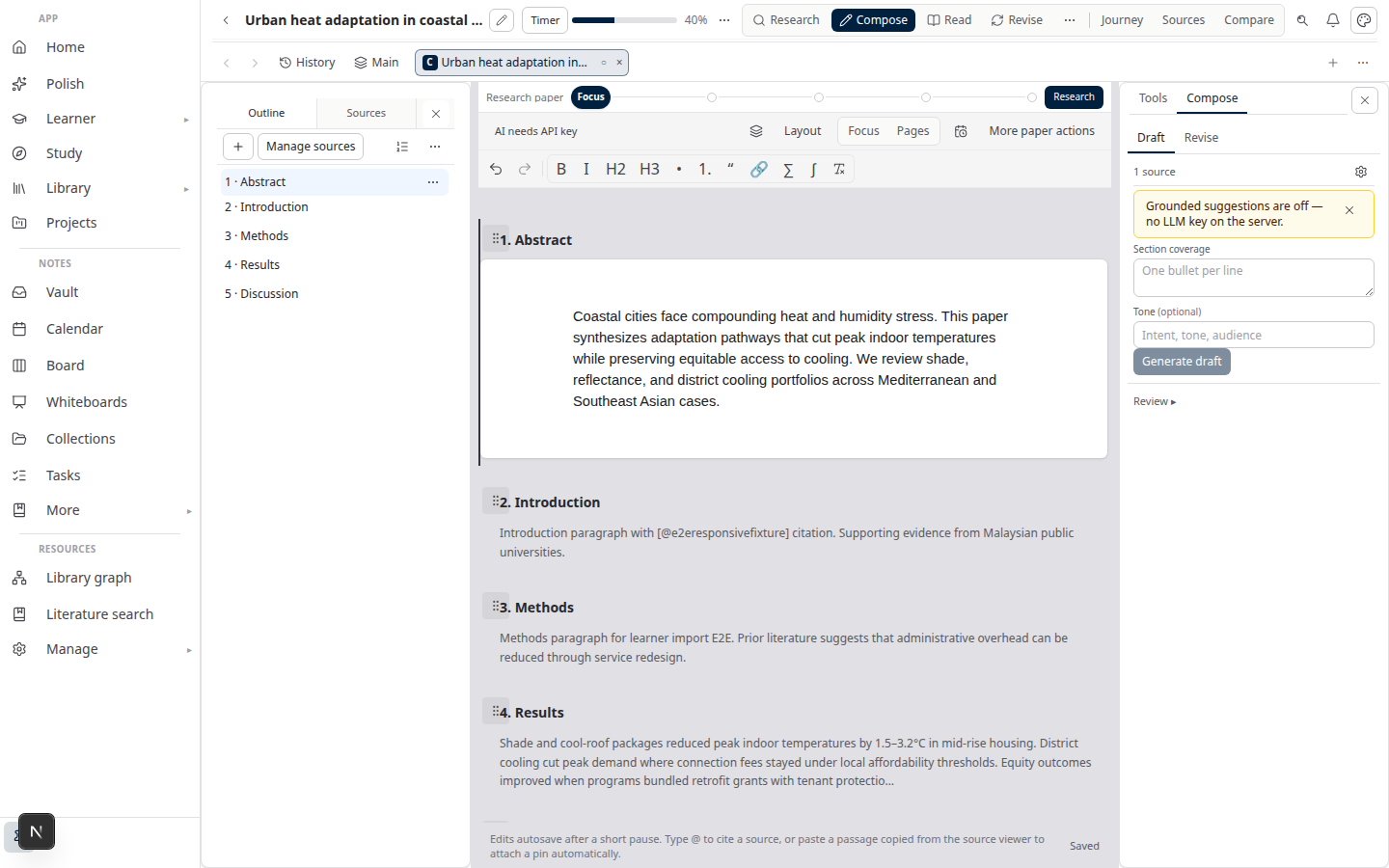
Quick comparison
| ChatGPT | Lattuce | |
|---|---|---|
| Core job | Brainstorm, outline, and polish in chat | Research + writing pipeline at lattuce.app |
| Sources | Whatever you paste or attach in a thread | Your PDF library, attached to a paper |
| Literature review | Chat summaries and suggested outlines | Discovery and review missions with an evidence matrix |
| Citations | May invent references | Cite chips from attached PDFs, then citation checks |
| Manuscript | Copy-paste into your editor | Section approval → Word (DOCX) with a bibliography |
| Setup | Zero research setup — open a chat | Sign up at lattuce.app; optional your own AI keys |
| Account | Individual ChatGPT account | Household account |
| Study | Recap in the same chat | Study digest over your PDFs |
| Translation | General translation in chat | Collaborative translation for multilingual papers |
| Co-editing | Shared chats, not a paper workspace | No real-time co-edit on paper sections |
| Zotero | — | Import and .bib export; citations are not written back |
When to use which
| Need | Use |
|---|---|
| Brainstorm a topic or sharpen a research question | ChatGPT |
| Sketch an outline before you have sources | ChatGPT |
| Polish general prose that is not citation-critical | ChatGPT |
| Explore a literature question in conversation, no library | ChatGPT |
| Discover and review literature against sources you keep | Lattuce |
| Audit an evidence matrix before anyone drafts prose | Lattuce |
| Insert cite chips from attached PDFs and run citation checks | Lattuce |
| Export an approved Word file with a real bibliography | Lattuce |
| Run a Study digest over a reading pile you own | Lattuce |
| Translate a paper collaboratively with colleagues | Lattuce |
A common pattern: start in ChatGPT for ideation, then move the work into Lattuce for the cited draft. ChatGPT helps you find the question; Lattuce helps you answer it with sources you can defend.
For corpus-scale search of papers you do not yet own, see Elicit vs Lattuce. Elicit still wins that discovery job. Bring the shortlist into Lattuce to write.
What ChatGPT still wins
- Brainstorming — no library to upload, no paper project to create. You can talk through a muddy topic in minutes.
- Outline help — a fast chapter or section skeleton before you know which PDFs matter.
- General writing polish — tone, clarity, and sentence-level edits on prose that is not citation-critical.
- Zero research setup — open a chat and start. There is no source library, mission, or approval gate.
- Conversational exploration — useful when you are still deciding what the review is about.
Those strengths are real. They are also why ChatGPT literature review drafts can look finished while the references are not. ChatGPT may invent citations. Treat any reference it offers as a lead to verify, not as a bibliography.
What Lattuce wins
- Literature missions with an evidence matrix — discovery proposes papers you approve; a literature review mission synthesizes attached, ready PDFs into a report you can audit. See Research missions in Lattuce.
- Cite chips from attached PDFs — compose from synthesis with citations tied to sources on the paper, not names remembered from a chat.
- Citation checks — Writer checks claims against your library before you treat a section as done.
- Approved Word export with real references — sections go through approval, then export to DOCX with a bibliography. Walk the pipeline in Sources to DOCX in Lattuce.
- Household account — one research workspace for a family, small lab, or thesis group — not a pile of personal chat threads.
- Optional your own AI keys — configure provider keys in settings if you prefer.
- Study digest — recap the PDFs you keep, then continue into Writer when the digest should become a cited chapter.
- Collaborative translation — multilingual papers with a shared translation workflow, useful when a lab works across languages.
Honest limits: Lattuce does not write citations back to Zotero, and it does not real-time co-edit paper sections. Approval and export integrity come first. Keep Zotero as the reference manager; keep Google Docs or similar for memos that need live cursors.
The full author path — catalog browse, discovery, review mission, compose, approve, Word — is in Literature review with Lattuce.
Bottom line
Choose ChatGPT when you need a thinking partner with no setup: brainstorm, outline, polish, explore. Choose Lattuce when an academic literature review must end as a cited, exportable Word file built on a library you keep. Many authors will use ChatGPT first, then Lattuce for the draft they can submit.
See also: Lattuce vs research apps · Elicit vs Lattuce · Literature review with Lattuce
Bahasa Melayu: ChatGPT vs Lattuce untuk kajian literatur — sumbang saran atau eksport Word bersitasi?