Loading home
Loading home
Skip to content
Blog
  1. Blog
  2. /
  3. Tool comparisons
  4. /
  5. Perplexity Academic vs Lattuce missions — web search chat or library-grounded synthesis?

May 29, 2027 · Tool comparisons

Perplexity Academic vs Lattuce missions — web search chat or library-grounded synthesis?

Perplexity Academic wins cited web search chat. Lattuce missions synthesize your library with an evidence matrix and compose handoff.

  • comparison
  • perplexity
  • missions
  • literature-review
  • seo
LanguageEnglishBahasa Melayu

Perplexity Academic is open-web search chat: ask a question, get an answer with citations to pages on the live web. Lattuce missions at lattuce.app are structured jobs over your attached library — a synthesis report and evidence matrix you can audit, then a compose handoff into Writer.

In short: use Perplexity Academic when you need a cited answer from the open web. Use Lattuce when the question is “what do my sources say, and can I draft from that?” Perplexity is not a writing suite. Lattuce is not a general web answer engine.
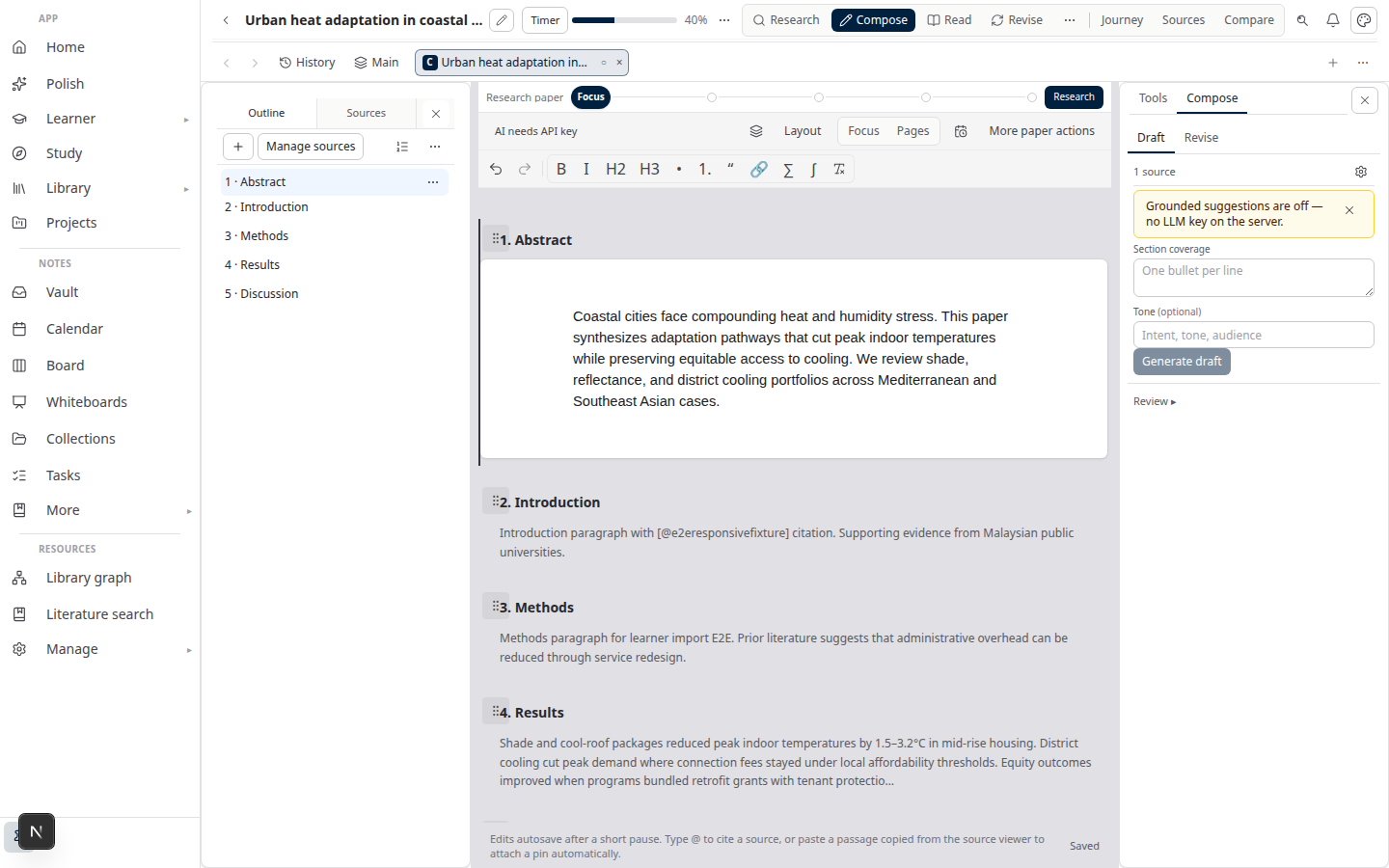
Lattuce Writer — from sources to cited draft

Quick comparison

Perplexity AcademicLattuce
Core jobCited answers from live web searchResearch + writing pipeline at lattuce.app
SourcesThe open web (and whatever you paste in chat)Your PDF library, attached to a paper
SynthesisA chat reply with web citationsLiterature review mission over attached, ready sources
EvidenceLinks in the answerReviewable evidence matrix plus a synthesis report
CitationsPages Perplexity found on the webCite chips from sources on the paper, then citation checks
Next stepKeep chatting, or copy the answer outCompose from synthesis into Writer sections
ManuscriptNot a writing suite — no section approval or Word exportSection approval → Word (DOCX) with a bibliography
DiscoveryOpen-web search in the same chatScholarly catalogs and a discovery mission you approve
SetupOpen a chat — no library to buildSign up at lattuce.app; optional your own AI keys
AccountIndividual Perplexity accountHousehold account

When to use which

NeedUse
A fast, cited answer from the live webPerplexity Academic
Orient on a topic before you have PDFsPerplexity Academic
Follow a news, preprint, or web trail as it appearsPerplexity Academic
Ask a question without uploading a libraryPerplexity Academic
Synthesize sources you already keep and can defendLattuce
Audit an evidence matrix before anyone drafts proseLattuce
Hand synthesis into Writer with cite chips from attached PDFsLattuce
Export an approved Word file with a real bibliographyLattuce
Browse scholarly catalogs, then attach papers you approveLattuce

A common pattern: start in Perplexity Academic to see what the web is saying, then move the papers you will actually cite into Lattuce. Perplexity orients you. Missions synthesize the library you keep.

For corpus-scale search of papers you do not yet own, see Elicit vs Lattuce. Elicit still wins that discovery job. For ideation with no search layer, see ChatGPT vs Lattuce for literature review.

What Perplexity Academic still wins

  • Open-web search chat — one box, a live index, and an answer with links. You do not build a library first.
  • Citations to the web — the reply points at pages Perplexity found, including news, repos, and papers that are public on the web.
  • Speed of orientation — useful when you are still deciding what the question is, or whether a topic is even live.
  • Following a changing trail — web search stays current in a way a fixed PDF pile does not.
  • Zero research setup — no paper project, no attachments, no mission timeline. Open a chat and ask.

Those strengths are real. They are also the limit. A cited chat answer is not a manuscript. Perplexity Academic does not give you section approval, an evidence matrix you own, or Word export with a bibliography tied to your library. Treat web citations as leads to verify, then keep the files you will defend.

What Lattuce wins

  • Library-grounded missions — a literature review mission synthesizes attached, ready sources into a report you can read before anyone writes prose. See Research missions in Lattuce.
  • Evidence matrix — scan which papers support which claims. Approve or reject before you treat the synthesis as canon.
  • Compose handoff — Compose from synthesis opens Writer with grounded starting text and cite chips tied to sources on the paper, not names remembered from a chat.
  • Scholarly catalog discovery — when the library is thin, a discovery mission searches open catalogs and proposes papers you approve. That is not general web search. The inventory is in Open catalogs Lattuce connects to.
  • Citation checks and Word export — Writer checks claims against your library; approved sections export to DOCX with a bibliography.
  • Household account — one research workspace for a family, small lab, or thesis group — not a pile of personal search threads.
  • Optional your own AI keys — configure provider keys in settings if you prefer.

Honest limits: Lattuce is not a general web answer engine. It does not replace Perplexity for “what is on the web right now?” Discovery uses scholarly catalogs, not the open web. Lattuce also does not write citations back to Zotero, and it does not real-time co-edit paper sections.

The full author path — catalog browse, discovery, review mission, compose, approve, Word — is in Literature review with Lattuce.

Using both together

These tools complement each other. A practical split:

  1. Ask Perplexity Academic to map the live conversation — who is writing, which preprints or news items keep coming up.
  2. Bring the papers you will cite into your Lattuce library (upload, catalog import, or a discovery mission).
  3. Attach ready sources to the paper and run a literature review mission.
  4. Audit the synthesis report and evidence matrix.
  5. Compose from synthesis, edit, run citation checks, approve sections, export Word.

Keep Perplexity for search chat. Keep Lattuce for the draft you can submit. Do not paste a Perplexity answer into Word and call it a literature review.

Bottom line

Choose Perplexity Academic when you need cited web search chat — a fast answer from the open web, with links. Choose Lattuce when synthesis must run over your attached library, leave an evidence matrix you can audit, and hand off into compose. Perplexity is not a writing suite. Lattuce is not a general web answer engine. Many authors will use both, in that order.

See also: Research missions in Lattuce · Literature review with Lattuce · ChatGPT vs Lattuce for literature review · Open catalogs Lattuce connects to · Lattuce vs research apps

Bahasa Melayu: Perplexity Academic vs misi Lattuce — sembang carian web atau sintesis berlandasan perpustakaan?

PreviousConsensus vs Lattuce — research Q&A search or cited writing pipeline?

Tool comparisons

  1. 1. Notion vs Lattuce — which research tool fits your workflow?
  2. 2. Using Lattuce alongside Notion
  3. 3. Lattuce vs research and team apps
  4. 4. Obsidian vs Lattuce — notes vault or full research workspace?
  5. 5. NotebookLM vs Lattuce — quick digest or full research workflow?
  6. 6. Heptabase vs Lattuce — visual thinking or cited academic writing?
  7. 7. Lattuce + Zotero — import, cite, and export without leaving your library
  8. 8. Fabric vs Lattuce — AI second brain or cited academic writing?
  9. 9. Overleaf vs Lattuce — LaTeX collaboration or grounded Word export pipeline?
  10. 10. Scrivener vs Lattuce — long-form structure vs research pipeline
  11. 11. Elicit and Consensus vs Lattuce — answer engines vs grounded research pipeline
  12. 12. AFFiNE vs Lattuce — doc-canvas fusion vs academic research layer
  13. 13. Logseq and Roam vs Lattuce — daily notes vs publish pipeline
  14. 14. Google Docs vs Lattuce — co-authored drafts vs citation-verified export
  15. 15. Elicit vs Lattuce — literature search or full research pipeline?
  16. 16. ChatGPT vs Lattuce for literature review — brainstorm or cited Word export?
  17. 17. Paperpile and Mendeley vs Lattuce — reference managers or writing pipeline?
  18. 18. Typst.app and Overleaf vs Lattuce — typesetting clouds or grounded Word export?
  19. 19. Consensus vs Lattuce — research Q&A search or cited writing pipeline?
  20. You are here20. Perplexity Academic vs Lattuce missions — web search chat or library-grounded synthesis?

On this page

  1. Quick comparison
  2. When to use which
  3. What Perplexity Academic still wins
  4. What Lattuce wins
  5. Using both together
  6. Bottom line

Explore Lattuce

Start writing, compare tools, or browse tutorials for your research stack.

Try LattuceTutorialsPlans

Subscribe to Tool comparisons: RSS · Atom

← All posts
TermsPrivacyCookiesRefundsFAQContact[email protected]

© Lattuce

Skip to content
Blog
  1. Blog
  2. /
  3. Tool comparisons
  4. /
  5. Perplexity Academic vs Lattuce missions — web search chat or library-grounded synthesis?

May 29, 2027 · Tool comparisons

Perplexity Academic vs Lattuce missions — web search chat or library-grounded synthesis?

Perplexity Academic wins cited web search chat. Lattuce missions synthesize your library with an evidence matrix and compose handoff.

  • comparison
  • perplexity
  • missions
  • literature-review
  • seo
LanguageEnglishBahasa Melayu

Perplexity Academic is open-web search chat: ask a question, get an answer with citations to pages on the live web. Lattuce missions at lattuce.app are structured jobs over your attached library — a synthesis report and evidence matrix you can audit, then a compose handoff into Writer.

In short: use Perplexity Academic when you need a cited answer from the open web. Use Lattuce when the question is “what do my sources say, and can I draft from that?” Perplexity is not a writing suite. Lattuce is not a general web answer engine.

Lattuce Writer — from sources to cited draft

Quick comparison

Perplexity AcademicLattuce
Core jobCited answers from live web searchResearch + writing pipeline at lattuce.app
SourcesThe open web (and whatever you paste in chat)Your PDF library, attached to a paper
SynthesisA chat reply with web citationsLiterature review mission over attached, ready sources
EvidenceLinks in the answerReviewable evidence matrix plus a synthesis report
CitationsPages Perplexity found on the webCite chips from sources on the paper, then citation checks
Next stepKeep chatting, or copy the answer outCompose from synthesis into Writer sections
ManuscriptNot a writing suite — no section approval or Word exportSection approval → Word (DOCX) with a bibliography
DiscoveryOpen-web search in the same chatScholarly catalogs and a discovery mission you approve
SetupOpen a chat — no library to buildSign up at lattuce.app; optional your own AI keys
AccountIndividual Perplexity accountHousehold account

When to use which

NeedUse
A fast, cited answer from the live webPerplexity Academic
Orient on a topic before you have PDFsPerplexity Academic
Follow a news, preprint, or web trail as it appearsPerplexity Academic
Ask a question without uploading a libraryPerplexity Academic
Synthesize sources you already keep and can defendLattuce
Audit an evidence matrix before anyone drafts proseLattuce
Hand synthesis into Writer with cite chips from attached PDFsLattuce
Export an approved Word file with a real bibliographyLattuce
Browse scholarly catalogs, then attach papers you approveLattuce

A common pattern: start in Perplexity Academic to see what the web is saying, then move the papers you will actually cite into Lattuce. Perplexity orients you. Missions synthesize the library you keep.

For corpus-scale search of papers you do not yet own, see Elicit vs Lattuce. Elicit still wins that discovery job. For ideation with no search layer, see ChatGPT vs Lattuce for literature review.

What Perplexity Academic still wins

  • Open-web search chat — one box, a live index, and an answer with links. You do not build a library first.
  • Citations to the web — the reply points at pages Perplexity found, including news, repos, and papers that are public on the web.
  • Speed of orientation — useful when you are still deciding what the question is, or whether a topic is even live.
  • Following a changing trail — web search stays current in a way a fixed PDF pile does not.
  • Zero research setup — no paper project, no attachments, no mission timeline. Open a chat and ask.

Those strengths are real. They are also the limit. A cited chat answer is not a manuscript. Perplexity Academic does not give you section approval, an evidence matrix you own, or Word export with a bibliography tied to your library. Treat web citations as leads to verify, then keep the files you will defend.

What Lattuce wins

  • Library-grounded missions — a literature review mission synthesizes attached, ready sources into a report you can read before anyone writes prose. See Research missions in Lattuce.
  • Evidence matrix — scan which papers support which claims. Approve or reject before you treat the synthesis as canon.
  • Compose handoff — Compose from synthesis opens Writer with grounded starting text and cite chips tied to sources on the paper, not names remembered from a chat.
  • Scholarly catalog discovery — when the library is thin, a discovery mission searches open catalogs and proposes papers you approve. That is not general web search. The inventory is in Open catalogs Lattuce connects to.
  • Citation checks and Word export — Writer checks claims against your library; approved sections export to DOCX with a bibliography.
  • Household account — one research workspace for a family, small lab, or thesis group — not a pile of personal search threads.
  • Optional your own AI keys — configure provider keys in settings if you prefer.

Honest limits: Lattuce is not a general web answer engine. It does not replace Perplexity for “what is on the web right now?” Discovery uses scholarly catalogs, not the open web. Lattuce also does not write citations back to Zotero, and it does not real-time co-edit paper sections.

The full author path — catalog browse, discovery, review mission, compose, approve, Word — is in Literature review with Lattuce.

Using both together

These tools complement each other. A practical split:

  1. Ask Perplexity Academic to map the live conversation — who is writing, which preprints or news items keep coming up.
  2. Bring the papers you will cite into your Lattuce library (upload, catalog import, or a discovery mission).
  3. Attach ready sources to the paper and run a literature review mission.
  4. Audit the synthesis report and evidence matrix.
  5. Compose from synthesis, edit, run citation checks, approve sections, export Word.

Keep Perplexity for search chat. Keep Lattuce for the draft you can submit. Do not paste a Perplexity answer into Word and call it a literature review.

Bottom line

Choose Perplexity Academic when you need cited web search chat — a fast answer from the open web, with links. Choose Lattuce when synthesis must run over your attached library, leave an evidence matrix you can audit, and hand off into compose. Perplexity is not a writing suite. Lattuce is not a general web answer engine. Many authors will use both, in that order.

See also: Research missions in Lattuce · Literature review with Lattuce · ChatGPT vs Lattuce for literature review · Open catalogs Lattuce connects to · Lattuce vs research apps

Bahasa Melayu: Perplexity Academic vs misi Lattuce — sembang carian web atau sintesis berlandasan perpustakaan?

PreviousConsensus vs Lattuce — research Q&A search or cited writing pipeline?

Tool comparisons

  1. 1. Notion vs Lattuce — which research tool fits your workflow?
  2. 2. Using Lattuce alongside Notion
  3. 3. Lattuce vs research and team apps
  4. 4. Obsidian vs Lattuce — notes vault or full research workspace?
  5. 5. NotebookLM vs Lattuce — quick digest or full research workflow?
  6. 6. Heptabase vs Lattuce — visual thinking or cited academic writing?
  7. 7. Lattuce + Zotero — import, cite, and export without leaving your library
  8. 8. Fabric vs Lattuce — AI second brain or cited academic writing?
  9. 9. Overleaf vs Lattuce — LaTeX collaboration or grounded Word export pipeline?
  10. 10. Scrivener vs Lattuce — long-form structure vs research pipeline
  11. 11. Elicit and Consensus vs Lattuce — answer engines vs grounded research pipeline
  12. 12. AFFiNE vs Lattuce — doc-canvas fusion vs academic research layer
  13. 13. Logseq and Roam vs Lattuce — daily notes vs publish pipeline
  14. 14. Google Docs vs Lattuce — co-authored drafts vs citation-verified export
  15. 15. Elicit vs Lattuce — literature search or full research pipeline?
  16. 16. ChatGPT vs Lattuce for literature review — brainstorm or cited Word export?
  17. 17. Paperpile and Mendeley vs Lattuce — reference managers or writing pipeline?
  18. 18. Typst.app and Overleaf vs Lattuce — typesetting clouds or grounded Word export?
  19. 19. Consensus vs Lattuce — research Q&A search or cited writing pipeline?
  20. You are here20. Perplexity Academic vs Lattuce missions — web search chat or library-grounded synthesis?

On this page

  1. Quick comparison
  2. When to use which
  3. What Perplexity Academic still wins
  4. What Lattuce wins
  5. Using both together
  6. Bottom line

Explore Lattuce

Start writing, compare tools, or browse tutorials for your research stack.

Try LattuceTutorialsPlans

Subscribe to Tool comparisons: RSS · Atom

← All posts
TermsPrivacyCookiesRefundsFAQContact[email protected]

© Lattuce