Loading home
Loading home
Skip to content
Blog
  1. Blog
  2. /
  3. Tool comparisons
  4. /
  5. Overleaf vs Lattuce — LaTeX collaboration or grounded Word export pipeline?

October 31, 2026 · Tool comparisons

Overleaf vs Lattuce — LaTeX collaboration or grounded Word export pipeline?

Compare Overleaf and Lattuce for academic writing: real-time LaTeX vs section approval, citations, translation, and household accounts on lattuce.app.

  • comparison
  • overleaf
  • latex
  • docx
  • seo

Overleaf is the standard for collaborative LaTeX — real-time co-editing, journal templates, and a mature online compiler. Lattuce targets authors who need PDF sources, citation checks, and Word export at lattuce.app — not a LaTeX-first toolchain.

In short: use Overleaf when LaTeX and journal templates are required; use Lattuce when your pipeline ends in Word with verified references tied to your library.
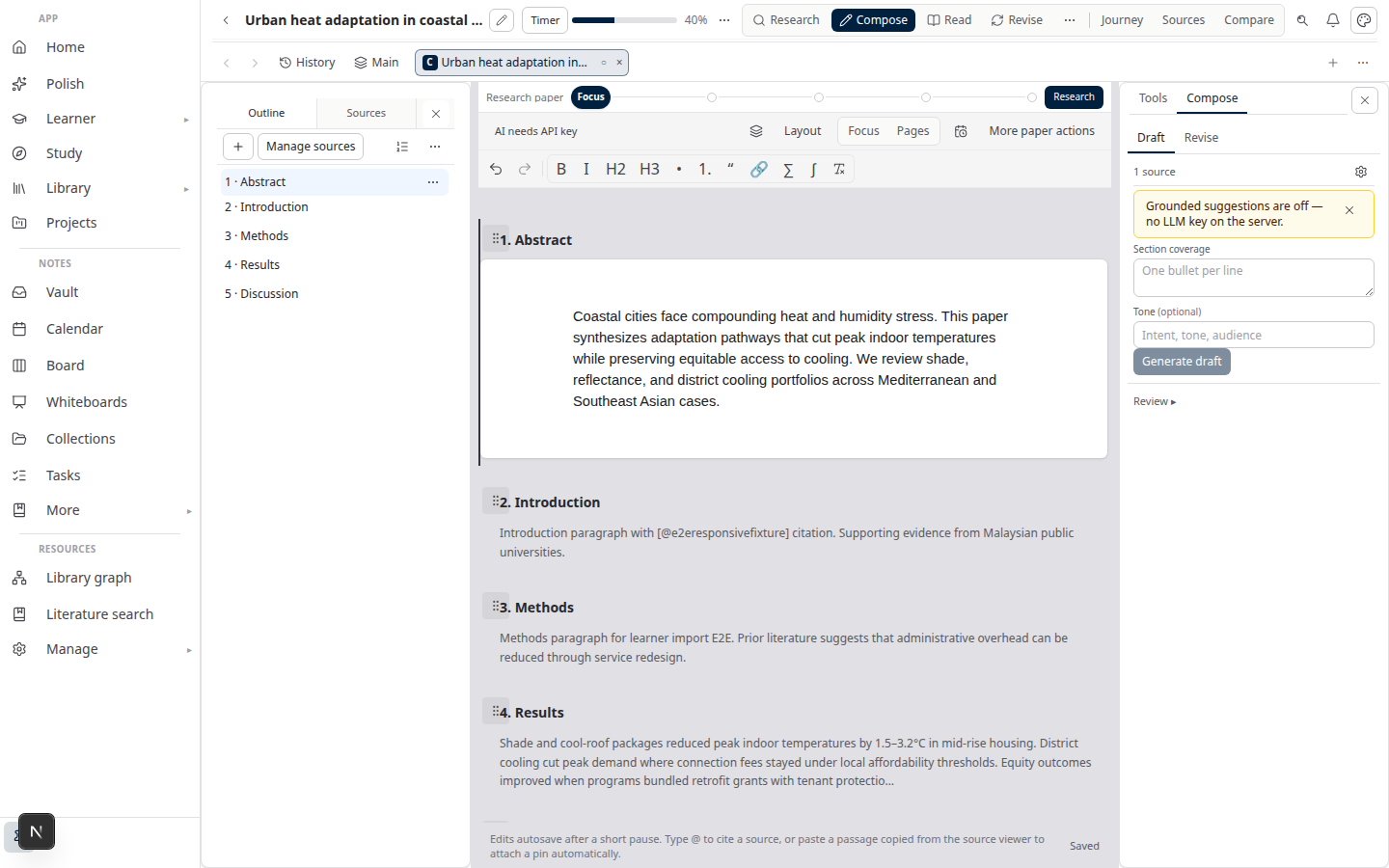
Lattuce Writer compose on lattuce.app

Quick comparison

OverleafLattuce
Core jobCollaborative LaTeXResearch + Word export at lattuce.app
Writing modelLaTeX source + compileSection drafts with citation checks
Real-time co-editStrong for co-authorsHousehold sharing; section approval focus
Journal templatesLarge galleryWord export; LaTeX not the primary path
PDF sourcesAttach or cite manuallyBuilt-in library and reader
Literature reviewExternal toolsMissions and synthesis in the product
TranslationExternalCollaborative translation linked to papers
Where it runsOverleaf cloudlattuce.app

When to use Overleaf

  • Journal or conference requires LaTeX
  • Co-authors already work in real-time LaTeX
  • You need publisher template packs out of the box
  • BibTeX + compile workflow is already your habit

When to use Lattuce

  • Final deliverable is Word, not PDF from LaTeX
  • Sections must cite PDFs in your library with verification
  • Literature review happens before drafting sections
  • Household or lab account at lattuce.app with translation needs
  • You want study and notes beside the manuscript

What Overleaf still wins

  • LaTeX compiler, templates, and co-editing at scale
  • Publisher and university partnerships
  • Mature SaaS for STEM co-authoring
  • No need to manage sources outside the project folder

What Lattuce wins

  • Writing tied to your sources — not free-form LaTeX cites
  • Section approval before Word export
  • Research missions with exported evidence
  • Study and notes on the same corpus
  • Collaborative translation for bilingual papers
  • One workspace for library, write, and learn

Using both

Some authors draft in Overleaf for LaTeX journals and use Lattuce for literature review, source library, and Word versions for supervisors. BibTeX handoff is possible when your workflow needs both.

Bottom line

Choose Overleaf for LaTeX collaboration and templates. Choose Lattuce for a source-grounded pipeline to Word at lattuce.app.

See also: Lattuce vs research apps · Literature review with Lattuce

PreviousFabric vs Lattuce — AI second brain or cited academic writing?NextScrivener vs Lattuce — long-form structure vs research pipeline

Tool comparisons

  1. 1. Notion vs Lattuce — which research tool fits your workflow?
  2. 2. Using Lattuce alongside Notion
  3. 3. Lattuce vs research and team apps
  4. 4. Obsidian vs Lattuce — notes vault or full research workspace?
  5. 5. NotebookLM vs Lattuce — quick digest or full research workflow?
  6. 6. Heptabase vs Lattuce — visual thinking or cited academic writing?
  7. 7. Lattuce + Zotero — import, cite, and export without leaving your library
  8. 8. Fabric vs Lattuce — AI second brain or cited academic writing?
  9. You are here9. Overleaf vs Lattuce — LaTeX collaboration or grounded Word export pipeline?
  10. 10. Scrivener vs Lattuce — long-form structure vs research pipeline
  11. 11. Elicit and Consensus vs Lattuce — answer engines vs grounded research pipeline
  12. 12. AFFiNE vs Lattuce — doc-canvas fusion vs academic research layer
  13. 13. Logseq and Roam vs Lattuce — daily notes vs publish pipeline
  14. 14. Google Docs vs Lattuce — co-authored drafts vs citation-verified export
  15. 15. Elicit vs Lattuce — literature search or full research pipeline?
  16. 16. ChatGPT vs Lattuce for literature review — brainstorm or cited Word export?
  17. 17. Paperpile and Mendeley vs Lattuce — reference managers or writing pipeline?
  18. 18. Typst.app and Overleaf vs Lattuce — typesetting clouds or grounded Word export?
  19. 19. Consensus vs Lattuce — research Q&A search or cited writing pipeline?
  20. 20. Perplexity Academic vs Lattuce missions — web search chat or library-grounded synthesis?

On this page

  1. Quick comparison
  2. When to use Overleaf
  3. When to use Lattuce
  4. What Overleaf still wins
  5. What Lattuce wins
  6. Using both
  7. Bottom line

Explore Lattuce

Start writing, compare tools, or browse tutorials for your research stack.

Try LattuceTutorialsPlans

Subscribe to Tool comparisons: RSS · Atom

← All posts
TermsPrivacyCookiesRefundsFAQContact[email protected]

© Lattuce

Skip to content
Blog
  1. Blog
  2. /
  3. Tool comparisons
  4. /
  5. Overleaf vs Lattuce — LaTeX collaboration or grounded Word export pipeline?

October 31, 2026 · Tool comparisons

Overleaf vs Lattuce — LaTeX collaboration or grounded Word export pipeline?

Compare Overleaf and Lattuce for academic writing: real-time LaTeX vs section approval, citations, translation, and household accounts on lattuce.app.

  • comparison
  • overleaf
  • latex
  • docx
  • seo

Overleaf is the standard for collaborative LaTeX — real-time co-editing, journal templates, and a mature online compiler. Lattuce targets authors who need PDF sources, citation checks, and Word export at lattuce.app — not a LaTeX-first toolchain.

In short: use Overleaf when LaTeX and journal templates are required; use Lattuce when your pipeline ends in Word with verified references tied to your library.

Lattuce Writer compose on lattuce.app

Quick comparison

OverleafLattuce
Core jobCollaborative LaTeXResearch + Word export at lattuce.app
Writing modelLaTeX source + compileSection drafts with citation checks
Real-time co-editStrong for co-authorsHousehold sharing; section approval focus
Journal templatesLarge galleryWord export; LaTeX not the primary path
PDF sourcesAttach or cite manuallyBuilt-in library and reader
Literature reviewExternal toolsMissions and synthesis in the product
TranslationExternalCollaborative translation linked to papers
Where it runsOverleaf cloudlattuce.app

When to use Overleaf

  • Journal or conference requires LaTeX
  • Co-authors already work in real-time LaTeX
  • You need publisher template packs out of the box
  • BibTeX + compile workflow is already your habit

When to use Lattuce

  • Final deliverable is Word, not PDF from LaTeX
  • Sections must cite PDFs in your library with verification
  • Literature review happens before drafting sections
  • Household or lab account at lattuce.app with translation needs
  • You want study and notes beside the manuscript

What Overleaf still wins

  • LaTeX compiler, templates, and co-editing at scale
  • Publisher and university partnerships
  • Mature SaaS for STEM co-authoring
  • No need to manage sources outside the project folder

What Lattuce wins

  • Writing tied to your sources — not free-form LaTeX cites
  • Section approval before Word export
  • Research missions with exported evidence
  • Study and notes on the same corpus
  • Collaborative translation for bilingual papers
  • One workspace for library, write, and learn

Using both

Some authors draft in Overleaf for LaTeX journals and use Lattuce for literature review, source library, and Word versions for supervisors. BibTeX handoff is possible when your workflow needs both.

Bottom line

Choose Overleaf for LaTeX collaboration and templates. Choose Lattuce for a source-grounded pipeline to Word at lattuce.app.

See also: Lattuce vs research apps · Literature review with Lattuce

PreviousFabric vs Lattuce — AI second brain or cited academic writing?NextScrivener vs Lattuce — long-form structure vs research pipeline

Tool comparisons

  1. 1. Notion vs Lattuce — which research tool fits your workflow?
  2. 2. Using Lattuce alongside Notion
  3. 3. Lattuce vs research and team apps
  4. 4. Obsidian vs Lattuce — notes vault or full research workspace?
  5. 5. NotebookLM vs Lattuce — quick digest or full research workflow?
  6. 6. Heptabase vs Lattuce — visual thinking or cited academic writing?
  7. 7. Lattuce + Zotero — import, cite, and export without leaving your library
  8. 8. Fabric vs Lattuce — AI second brain or cited academic writing?
  9. You are here9. Overleaf vs Lattuce — LaTeX collaboration or grounded Word export pipeline?
  10. 10. Scrivener vs Lattuce — long-form structure vs research pipeline
  11. 11. Elicit and Consensus vs Lattuce — answer engines vs grounded research pipeline
  12. 12. AFFiNE vs Lattuce — doc-canvas fusion vs academic research layer
  13. 13. Logseq and Roam vs Lattuce — daily notes vs publish pipeline
  14. 14. Google Docs vs Lattuce — co-authored drafts vs citation-verified export
  15. 15. Elicit vs Lattuce — literature search or full research pipeline?
  16. 16. ChatGPT vs Lattuce for literature review — brainstorm or cited Word export?
  17. 17. Paperpile and Mendeley vs Lattuce — reference managers or writing pipeline?
  18. 18. Typst.app and Overleaf vs Lattuce — typesetting clouds or grounded Word export?
  19. 19. Consensus vs Lattuce — research Q&A search or cited writing pipeline?
  20. 20. Perplexity Academic vs Lattuce missions — web search chat or library-grounded synthesis?

On this page

  1. Quick comparison
  2. When to use Overleaf
  3. When to use Lattuce
  4. What Overleaf still wins
  5. What Lattuce wins
  6. Using both
  7. Bottom line

Explore Lattuce

Start writing, compare tools, or browse tutorials for your research stack.

Try LattuceTutorialsPlans

Subscribe to Tool comparisons: RSS · Atom

← All posts
TermsPrivacyCookiesRefundsFAQContact[email protected]

© Lattuce