Loading home
Loading home
Skip to content
Blog
  1. Blog
  2. /
  3. Language learning
  4. /
  5. RemNote and Anki vs Lattuce Learner — flashcards or reading-first language learning?

May 12, 2027 · Language learning

RemNote and Anki vs Lattuce Learner — flashcards or reading-first language learning?

RemNote and Anki win flashcard craft and mobile. Lattuce Learner wins read→save→review from your texts at lingo.lattuce.app.

  • comparison
  • learner
  • anki
  • remnote
  • seo
LanguageEnglishBahasa Melayu

RemNote and Anki are card-first tools. You design prompts, cloze deletions, and decks, then review them on a mature spaced-repetition schedule — especially on the phone. Lattuce Learner (Lingo at lingo.lattuce.app) is reading-first: import your articles, books, or YouTube captions, tap words as you read, and review them on the same household account at lattuce.app.

In short: pick RemNote or Anki when you want to craft flashcards. Pick Lattuce Learner when vocabulary should come from texts you already chose — and sit beside Writer, not in a separate SRS app.
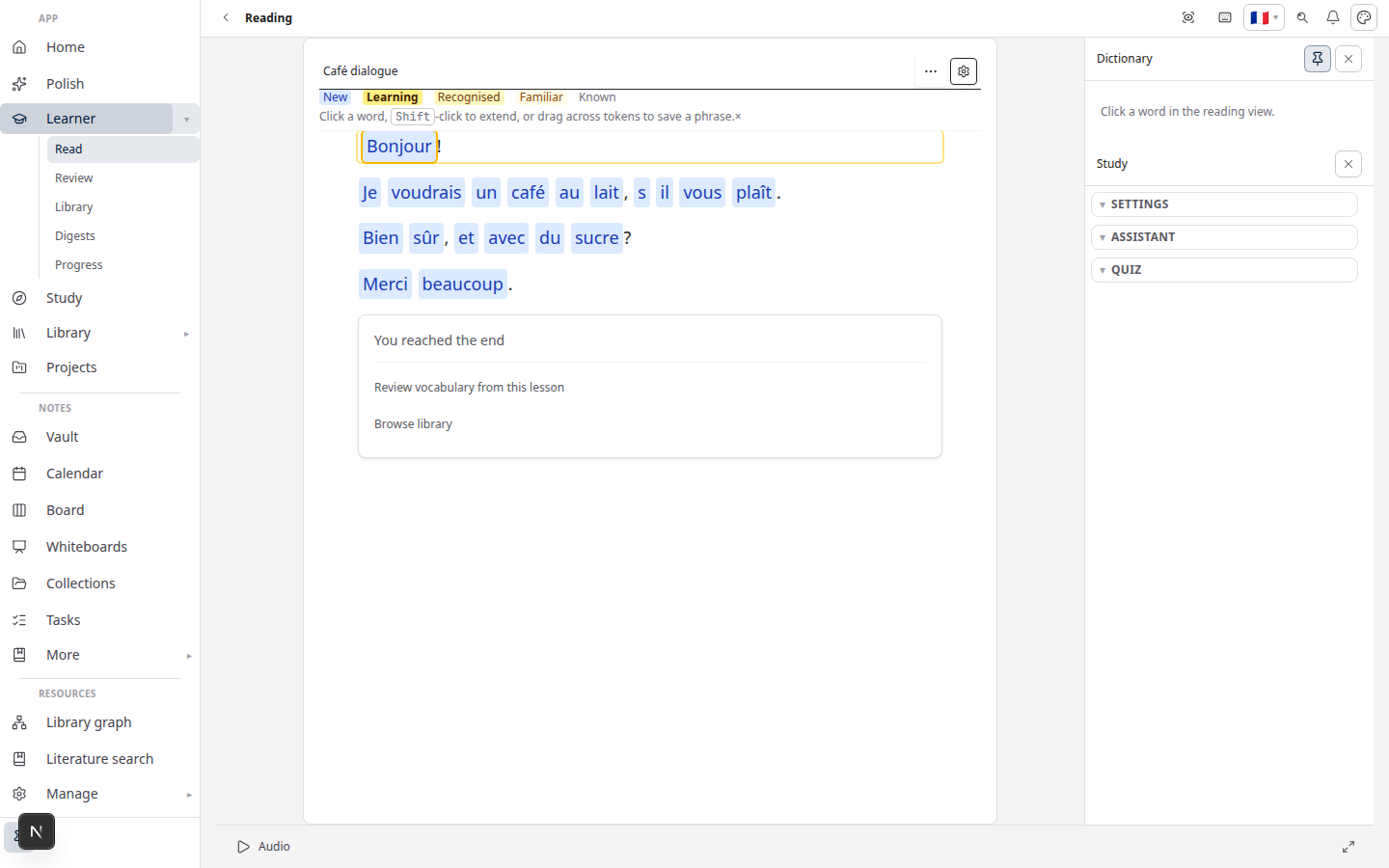
Lattuce Learner — read with word help and vocabulary review

Quick comparison

RemNoteAnkiLattuce Learner (Lingo)
Main jobNotes that become flashcardsDedicated spaced-repetition boxRead → save words → review
How cards appearYou write notes; cards come from those notesYou (or a shared deck) design each cardYou save words while reading your texts
Spaced repetitionBuilt into the notes appDeepest card craft and add-onsReview in the Learn menu
Your own textsNotes and PDFs you file as notesImport or type; not a readerArticles, paste, books, YouTube captions
YouTube / captionsNot the product’s jobPossible with extra workCaption import when enabled for your account
Research papersStudy notes, not a writing studioDecks onlyWriter bridge on the same account
HouseholdIndividual knowledge baseIndividual collectionsShared household at lattuce.app
MobileMature native appsMature iOS and AndroidWeb-first at lingo.lattuce.app
Exam PDFsNotes-and-cards over materials you fileAny subject you cardUse Study, not Learner — why

When to use which

Choose RemNote when…Choose Anki when…Choose Lattuce Learner when…
You want one notes vault that also quizzes youCard templates, cloze syntax, and add-ons matter mostProgress comes from reading material you pick
PDFs and lecture notes should become cardsYou already live in shared decksWords should come from your news, books, and captions
Native phone apps are non-negotiableYou review anywhere, including offline-first mobileLanguage study should share the household with Writer
The knowledge base is the productYou will maintain decks by handYou do not want a second SRS subscription or vault

Many people keep Anki or RemNote for grammar drills or exam facts, and use Learner for the reading loop. The tools do not have to replace each other.

What RemNote still wins

  • Notes and cards in one place — write a concept once; review it as a prompt later
  • Mature mobile apps — review and capture on the phone without opening a browser
  • Knowledge-base habits — links between notes, not only a review queue
  • PDF-as-notes — lecture slides and readings you already file as study material

RemNote is a strong fit when the unit of work is a note you authored. It is a weaker fit when the unit of work is a foreign-language article you want to finish.

What Anki still wins

  • Card craft — templates, cloze syntax, note types, and a large add-on ecosystem
  • Shared decks — start from community material instead of building every card
  • Mature mobile — AnkiDroid and AnkiMobile are the default for serious reviewers
  • Any subject — languages, medicine, law; Anki does not care what the card is about

Anki assumes you will make or import cards. If you would rather read first and let vocabulary appear from the page, that extra step is the tax.

What Lattuce Learner wins

  • Reading-first loop — import a text, tap words, review them later. No separate “make a deck” session. Start here: getting started with Lingo.
  • Your texts — news, books, pasted chapters, and YouTube captions, not only a shared deck someone else wrote.
  • Writer bridge — send a paper section into Learner and save words in context, instead of copying a paragraph into a card editor.
  • Household on lattuce.app — vocabulary and reading history live on the same account as Writer, Notes, and Library.
  • Review that follows the read — due cards in Review, from words you actually met on the page (how Review works).

Learner is a language-reading workspace. It does not try to out-Anki Anki on template editors or native offline apps.

Learner is not Study

Study helps you pass an exam from your uploaded PDFs — Q&A, course boards, digest. Learner helps you acquire a language by reading and reviewing vocabulary.

  • Course slides and past papers → Study
  • A Malay news article, a novel chapter, or a YouTube transcript → Learner

RemNote’s “notes become cards” habit can look like Study. It is still not Lattuce Study, and it is not Lattuce Learner. If the goal is exam prep over files you already have, read Study vs Learner first.

A reading-first routine (if you leave the card editor)

  1. Import an article, book, or captions at lingo.lattuce.app.
  2. Read and save words in the reader — the card is the word in that text.
  3. Open Review when cards are due.
  4. Optional: send a Writer section into Learner when the paper’s source language is the one you are learning.

That is the same loop as other reading apps, on your household account — see LingQ vs Lattuce Learner if you are comparing hosted readers rather than SRS boxes.

Bottom line

RemNote and Anki still win if your bottleneck is card craft and mature mobile review. Lattuce Learner wins if your bottleneck is staying inside real texts — save words from what you read, review them on a schedule, and keep language study on the same household as Writer at lingo.lattuce.app.

Use the SRS box when you need one. Use Learner when the page comes first.

Related reading

  • Getting started with Lingo
  • Spaced repetition in Lattuce Learner
  • Study vs Learner
  • LingQ vs Lattuce Learner

Bahasa Melayu: RemNote dan Anki vs Lattuce Learner — kad imbas atau belajar bahasa melalui bacaan?

PreviousCommunity library in Lattuce Learner — share and browse lessonsNextRead the news in Malay with Lattuce Lingo

Language learning

  1. 1. Learn languages by reading — getting started with Lingo by Lattuce
  2. 2. LingQ vs Lattuce Learner — which reading app fits your household?
  3. 3. Duolingo vs Lattuce Learner — daily lessons or real reading?
  4. 4. How to import articles and books into Lattuce Learner
  5. 5. Spaced repetition in Lattuce Learner — remember the words you save
  6. 6. From Writer to Learner — study foreign sources while you write
  7. 7. Lingo on lattuce.app — Learner beside Writer
  8. 8. Learn Malay and English by reading — bilingual households on Lattuce
  9. 9. Strands, Links, and Lattice — how Lattuce tracks the words you learn
  10. 10. Learn from YouTube captions with Lattuce Learner
  11. 11. Readlang vs Lattuce Learner — extension reader or household Lingo?
  12. 12. Community library in Lattuce Learner — share and browse lessons
  13. You are here13. RemNote and Anki vs Lattuce Learner — flashcards or reading-first language learning?
  14. 14. Read the news in Malay with Lattuce Lingo
  15. 15. Family shared vocabulary on one Lattuce household

On this page

  1. Quick comparison
  2. When to use which
  3. What RemNote still wins
  4. What Anki still wins
  5. What Lattuce Learner wins
  6. Learner is not Study
  7. A reading-first routine (if you leave the card editor)
  8. Bottom line
  9. Related reading

Explore Lattuce

Try language learning on lingo.lattuce.app or read the workflow guides.

Try LattuceTutorialsPlansLearner

Subscribe to Language learning: RSS · Atom

← All posts
TermsPrivacyCookiesRefundsFAQContact[email protected]

© Lattuce

Skip to content
Blog
  1. Blog
  2. /
  3. Language learning
  4. /
  5. RemNote and Anki vs Lattuce Learner — flashcards or reading-first language learning?

May 12, 2027 · Language learning

RemNote and Anki vs Lattuce Learner — flashcards or reading-first language learning?

RemNote and Anki win flashcard craft and mobile. Lattuce Learner wins read→save→review from your texts at lingo.lattuce.app.

  • comparison
  • learner
  • anki
  • remnote
  • seo
LanguageEnglishBahasa Melayu

RemNote and Anki are card-first tools. You design prompts, cloze deletions, and decks, then review them on a mature spaced-repetition schedule — especially on the phone. Lattuce Learner (Lingo at lingo.lattuce.app) is reading-first: import your articles, books, or YouTube captions, tap words as you read, and review them on the same household account at lattuce.app.

In short: pick RemNote or Anki when you want to craft flashcards. Pick Lattuce Learner when vocabulary should come from texts you already chose — and sit beside Writer, not in a separate SRS app.

Lattuce Learner — read with word help and vocabulary review

Quick comparison

RemNoteAnkiLattuce Learner (Lingo)
Main jobNotes that become flashcardsDedicated spaced-repetition boxRead → save words → review
How cards appearYou write notes; cards come from those notesYou (or a shared deck) design each cardYou save words while reading your texts
Spaced repetitionBuilt into the notes appDeepest card craft and add-onsReview in the Learn menu
Your own textsNotes and PDFs you file as notesImport or type; not a readerArticles, paste, books, YouTube captions
YouTube / captionsNot the product’s jobPossible with extra workCaption import when enabled for your account
Research papersStudy notes, not a writing studioDecks onlyWriter bridge on the same account
HouseholdIndividual knowledge baseIndividual collectionsShared household at lattuce.app
MobileMature native appsMature iOS and AndroidWeb-first at lingo.lattuce.app
Exam PDFsNotes-and-cards over materials you fileAny subject you cardUse Study, not Learner — why

When to use which

Choose RemNote when…Choose Anki when…Choose Lattuce Learner when…
You want one notes vault that also quizzes youCard templates, cloze syntax, and add-ons matter mostProgress comes from reading material you pick
PDFs and lecture notes should become cardsYou already live in shared decksWords should come from your news, books, and captions
Native phone apps are non-negotiableYou review anywhere, including offline-first mobileLanguage study should share the household with Writer
The knowledge base is the productYou will maintain decks by handYou do not want a second SRS subscription or vault

Many people keep Anki or RemNote for grammar drills or exam facts, and use Learner for the reading loop. The tools do not have to replace each other.

What RemNote still wins

  • Notes and cards in one place — write a concept once; review it as a prompt later
  • Mature mobile apps — review and capture on the phone without opening a browser
  • Knowledge-base habits — links between notes, not only a review queue
  • PDF-as-notes — lecture slides and readings you already file as study material

RemNote is a strong fit when the unit of work is a note you authored. It is a weaker fit when the unit of work is a foreign-language article you want to finish.

What Anki still wins

  • Card craft — templates, cloze syntax, note types, and a large add-on ecosystem
  • Shared decks — start from community material instead of building every card
  • Mature mobile — AnkiDroid and AnkiMobile are the default for serious reviewers
  • Any subject — languages, medicine, law; Anki does not care what the card is about

Anki assumes you will make or import cards. If you would rather read first and let vocabulary appear from the page, that extra step is the tax.

What Lattuce Learner wins

  • Reading-first loop — import a text, tap words, review them later. No separate “make a deck” session. Start here: getting started with Lingo.
  • Your texts — news, books, pasted chapters, and YouTube captions, not only a shared deck someone else wrote.
  • Writer bridge — send a paper section into Learner and save words in context, instead of copying a paragraph into a card editor.
  • Household on lattuce.app — vocabulary and reading history live on the same account as Writer, Notes, and Library.
  • Review that follows the read — due cards in Review, from words you actually met on the page (how Review works).

Learner is a language-reading workspace. It does not try to out-Anki Anki on template editors or native offline apps.

Learner is not Study

Study helps you pass an exam from your uploaded PDFs — Q&A, course boards, digest. Learner helps you acquire a language by reading and reviewing vocabulary.

  • Course slides and past papers → Study
  • A Malay news article, a novel chapter, or a YouTube transcript → Learner

RemNote’s “notes become cards” habit can look like Study. It is still not Lattuce Study, and it is not Lattuce Learner. If the goal is exam prep over files you already have, read Study vs Learner first.

A reading-first routine (if you leave the card editor)

  1. Import an article, book, or captions at lingo.lattuce.app.
  2. Read and save words in the reader — the card is the word in that text.
  3. Open Review when cards are due.
  4. Optional: send a Writer section into Learner when the paper’s source language is the one you are learning.

That is the same loop as other reading apps, on your household account — see LingQ vs Lattuce Learner if you are comparing hosted readers rather than SRS boxes.

Bottom line

RemNote and Anki still win if your bottleneck is card craft and mature mobile review. Lattuce Learner wins if your bottleneck is staying inside real texts — save words from what you read, review them on a schedule, and keep language study on the same household as Writer at lingo.lattuce.app.

Use the SRS box when you need one. Use Learner when the page comes first.

Related reading

  • Getting started with Lingo
  • Spaced repetition in Lattuce Learner
  • Study vs Learner
  • LingQ vs Lattuce Learner

Bahasa Melayu: RemNote dan Anki vs Lattuce Learner — kad imbas atau belajar bahasa melalui bacaan?

PreviousCommunity library in Lattuce Learner — share and browse lessonsNextRead the news in Malay with Lattuce Lingo

Language learning

  1. 1. Learn languages by reading — getting started with Lingo by Lattuce
  2. 2. LingQ vs Lattuce Learner — which reading app fits your household?
  3. 3. Duolingo vs Lattuce Learner — daily lessons or real reading?
  4. 4. How to import articles and books into Lattuce Learner
  5. 5. Spaced repetition in Lattuce Learner — remember the words you save
  6. 6. From Writer to Learner — study foreign sources while you write
  7. 7. Lingo on lattuce.app — Learner beside Writer
  8. 8. Learn Malay and English by reading — bilingual households on Lattuce
  9. 9. Strands, Links, and Lattice — how Lattuce tracks the words you learn
  10. 10. Learn from YouTube captions with Lattuce Learner
  11. 11. Readlang vs Lattuce Learner — extension reader or household Lingo?
  12. 12. Community library in Lattuce Learner — share and browse lessons
  13. You are here13. RemNote and Anki vs Lattuce Learner — flashcards or reading-first language learning?
  14. 14. Read the news in Malay with Lattuce Lingo
  15. 15. Family shared vocabulary on one Lattuce household

On this page

  1. Quick comparison
  2. When to use which
  3. What RemNote still wins
  4. What Anki still wins
  5. What Lattuce Learner wins
  6. Learner is not Study
  7. A reading-first routine (if you leave the card editor)
  8. Bottom line
  9. Related reading

Explore Lattuce

Try language learning on lingo.lattuce.app or read the workflow guides.

Try LattuceTutorialsPlansLearner

Subscribe to Language learning: RSS · Atom

← All posts
TermsPrivacyCookiesRefundsFAQContact[email protected]

© Lattuce